

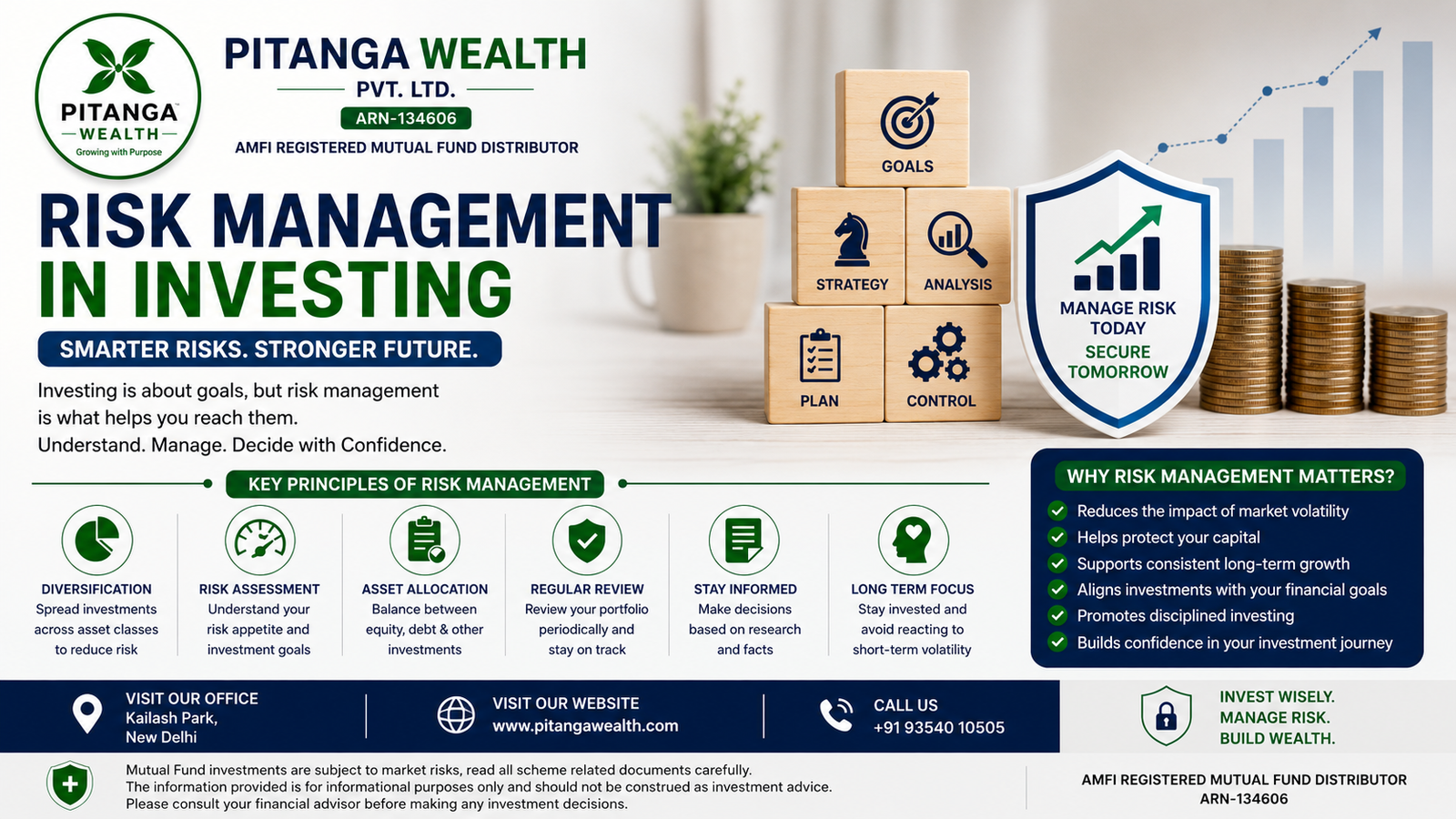
Investing is often discussed in terms of returns, but the other side of the equation deserves just as much attention: risk.
Every investment carries some degree of uncertainty. The value of an investment can rise or fall, expected income may not materialise, and market conditions can change unexpectedly. Good risk management does not mean trying to eliminate every possible loss. Instead, it means understanding the risks involved and making investment decisions that are consistent with your financial goals, time horizon and ability to tolerate losses.
This is particularly important for new investors, who may be influenced by market excitement, social-media discussions or promises of unusually high returns.
SEBI’s investor-education material encourages investors to understand the risks involved, consider their investment objective and risk appetite, conduct appropriate due diligence, and avoid making decisions based solely on tips or rumours.
What Is Risk Management in Investing?
Risk management in investing is the process of identifying, understanding and managing the potential risks associated with an investment.
Before investing, an investor can consider questions such as:
- What could cause the investment to lose value?
- How much loss could I financially tolerate?
- How long can I remain invested?
- Does the investment match my financial objective?
- Is my portfolio sufficiently diversified?
- Do I understand the product, its costs and its risks?
- Am I relying on verified information or simply following a market tip?
The answers will differ from one investor to another. There is no single level of investment risk that is appropriate for everyone.
Risk and return are connected
In general, investments with greater potential for returns can also involve greater uncertainty and the possibility of larger losses. However, higher risk does not guarantee higher returns.
This distinction matters. An investment should not be considered attractive simply because someone claims that it can generate a high return.
SEBI investor-awareness resources specifically caution investors against promises of guaranteed or unrealistic returns and against relying on unsolicited investment tips.
Why Is Risk Management Important?
Without considering risk, investors may focus too heavily on what they could gain and overlook what they could lose.
Effective risk management can help investors:
- Set realistic expectations
Markets do not move in a predictable straight line. Understanding this can help investors prepare for periods of volatility. - Avoid taking more risk than they can handle
An investment that appears suitable during a rising market may feel very different during a significant decline. - Protect long-term financial goals
Taking excessive risk can potentially interfere with goals if losses occur at an unsuitable time. - Reduce emotional decision-making
A predefined approach to risk can make it easier to avoid impulsive reactions to short-term market movements. - Make more informed decisions
Understanding the downside of an investment is an important part of understanding the investment itself.
Types of Investment Risk Investors Should Understand
Investment risk is not limited to fluctuations in market prices. Different investments can be exposed to different types of risk.
1. Market Risk
Market risk is the possibility that the value of an investment may decline because of changes in broader market conditions.
Equity markets, for example, can be affected by economic conditions, interest rates, corporate developments, geopolitical events, investor sentiment and other factors.
Market movements are normal, and past market performance cannot guarantee future results.
2. Volatility Risk
Volatility refers to how significantly and how quickly the price of an investment can move.
An investment with substantial short-term price movements may be difficult for an investor to hold comfortably if the investor has a low tolerance for fluctuations.
Volatility itself is not necessarily a permanent loss, but selling during an unfavourable period can turn a temporary decline into a realised loss.
3. Liquidity Risk
Liquidity risk refers to the possibility that an investor may not be able to buy or sell an investment easily at a desired price.
Some investments may have limited trading activity or other restrictions. Before investing, it is important to understand how and when the investment can be bought or sold.
An investor who may need access to money in the near future should pay particular attention to liquidity.
4. Credit or Default Risk
Certain investments involve the possibility that a borrower or issuer may fail to meet its financial obligations.
This is particularly relevant when considering debt-related investments. Investors should understand the credit quality, terms, repayment structure and other relevant risks rather than assuming that every debt instrument carries the same level of risk.
5. Interest Rate Risk
Changes in interest rates can affect the value of certain investments, particularly fixed-income securities.
The effect can vary depending on the type of investment, its maturity and other characteristics.
Understanding how interest-rate movements can affect an investment is therefore an important part of evaluating risk.
6. Inflation Risk
Inflation reduces the purchasing power of money over time.
Even if an investment does not lose money in nominal terms, its real purchasing power may decline if its returns do not keep pace with inflation.
For long-term financial planning, investors may therefore need to consider both investment risk and the effect of inflation.
7. Concentration Risk
Concentration risk arises when too much of a portfolio is exposed to a particular investment, company, sector, asset class or other area.
If that area performs poorly, a concentrated portfolio can be affected more significantly than a more diversified one.
This is one reason diversification is commonly discussed as a risk-management principle.
How Does Diversification Help Manage Investment Risk?
Diversification means spreading investments across different assets or exposures rather than relying excessively on a single investment.
The underlying idea is straightforward: if different investments do not respond identically to the same events, poor performance in one area may have a smaller effect on the overall portfolio.
However, diversification does not eliminate investment risk or guarantee profits.
For example, owning several securities within the same sector may provide less diversification than an investor expects because they may still be exposed to similar economic or industry-specific factors.
Diversification should therefore be considered thoughtfully rather than simply counting the number of investments in a portfolio.
Understand Your Risk Appetite Before Investing
Risk appetite refers broadly to the level of investment risk an investor is willing and able to accept.
Two people with identical incomes may have very different financial circumstances, goals, responsibilities and reactions to losses. Consequently, an investment approach that is suitable for one person may not be suitable for another.
Before making an investment decision, consider:
- Your financial objectives
- Your investment time horizon
- Your income and financial commitments
- Your need for liquidity
- Your ability to withstand losses
- Your willingness to accept market fluctuations
- Your existing investments and overall exposure
SEBI’s investor guidance specifically recommends investing according to one’s investment objective and risk appetite.
Risk Capacity vs Risk Tolerance
These two concepts are related but not identical.
Risk tolerance describes how comfortable an investor is with uncertainty or losses.
Risk capacity refers to how much financial loss an investor can actually withstand without seriously affecting their financial objectives or financial stability.
An investor may psychologically be comfortable with substantial market fluctuations but may not have the financial capacity to withstand a large loss.
Considering both can lead to a more balanced understanding of investment risk.
A Simple Risk-Management Process for Investors
Risk management does not need to be complicated. A basic framework can help investors think through an investment before committing money.
Step 1: Define the objective
Start by asking why you are investing.
Is the objective long-term wealth creation, a future financial requirement, retirement planning, or another goal?
The objective influences the time horizon and the amount of uncertainty that may be reasonable to consider.
Step 2: Determine the time horizon
An investor who may need the money soon may have less flexibility to tolerate a significant decline than someone investing for a much longer period.
The investment horizon should therefore be considered alongside risk.
Step 3: Understand the investment
Do not invest in something simply because it is popular.
Read the relevant documents and understand:
- How the investment works
- What can cause its value to decline
- What fees or charges apply
- How it generates potential returns
- What liquidity restrictions exist
- What risks have been disclosed
SEBI’s investor charter advises investors to read and understand documents carefully before investing and to be aware of applicable fees, charges and other costs.
Step 4: Consider diversification
Review whether your proposed investment would create excessive exposure to one company, sector, asset class or type of risk.
Step 5: Avoid decisions based on tips and rumours
A stock tip, social-media post or message promising quick profits is not a substitute for research.
SEBI specifically advises investors not to make investment decisions based on hot tips and encourages independent research rather than blindly following investment advice on social media.
Step 6: Review periodically
Your financial circumstances and goals can change.
Periodic reviews can help you determine whether your investments continue to be consistent with your objectives and risk tolerance. A review does not necessarily mean frequently buying and selling investments.
Common Risk-Management Mistakes to Avoid
Some mistakes can increase investment risk unnecessarily.
Investing because of FOMO
Fear of missing out can encourage investors to enter an investment after a sharp price movement or during periods of intense market enthusiasm.
A rising price is not proof that an investment will continue rising.
Chasing guaranteed returns
Claims of guaranteed or unusually high returns should be approached with caution.
SEBI’s investor-awareness resources repeatedly warn investors about assured-return schemes and unrealistic return promises.
Putting too much money into one investment
Concentration can magnify the effect of an adverse event affecting that investment.
Borrowing money to invest without understanding the risks
Using borrowed money can increase the financial consequences of an investment loss. SEBI’s investor guidance explicitly advises investors not to borrow money for investment.
Ignoring fees and other costs
Charges, brokerage, taxes and other expenses can affect the overall outcome of an investment. Investors should understand the applicable costs before proceeding.
Treating past performance as a promise
Historical returns are information about the past, not a guarantee of future performance.
Risk Management Is Not the Same as Avoiding All Risk
It is impossible to remove all investment risk.
Even conservative investment choices can be affected by factors such as inflation, interest-rate changes, liquidity conditions or changes in the broader economy.
The objective of risk management is therefore not necessarily to find an investment with “no risk.” Instead, it is about understanding the risks you are taking and considering whether those risks are appropriate for your circumstances.
That shift in thinking can be valuable for both new and experienced investors.
When Should You Seek Professional Advice?
Some investment decisions can involve significant complexity. If you are uncertain about whether an investment is appropriate for your circumstances, consider seeking advice from an appropriately qualified and SEBI-registered Investment Adviser, where relevant.
Investors should independently verify the registration status and credentials of any person or entity offering regulated investment advice.
Importantly, educational information should not be confused with personalised investment advice. A general article cannot assess an individual’s complete financial situation, objectives and risk profile.
Final Thoughts
Risk management is an essential part of becoming a more informed investor.
Instead of asking only, “How much can I make?”, a better starting point is often:
“What could go wrong, how much could I lose, and can I financially and emotionally handle that outcome?”
Understanding market risk, liquidity risk, concentration risk, inflation, credit risk and other relevant factors can help investors approach financial decisions more thoughtfully.
There is no universal investment strategy that is suitable for everyone. Investment decisions should be based on an individual’s objectives, circumstances, risk appetite and understanding of the product.
Most importantly, investors should rely on credible information, read relevant documents, conduct appropriate research and remain cautious of unsolicited tips and unrealistic return promises.
Important Disclaimer
This article is provided solely for educational and informational purposes and should not be construed as investment advice, a recommendation, solicitation or an offer to buy or sell any securities or financial products. The information presented is general in nature and does not take into account any individual’s financial situation, investment objectives, risk profile or circumstances. Investors should conduct their own research and carefully review relevant documents before making any investment decision. Where appropriate, investors may consult a SEBI-registered Investment Adviser for personalised advice. Investments in securities market are subject to market risks. Please read all relevant documents carefully before investing.
This article is for educational and informational purposes only. It is not investment, tax, legal or insurance advice. Consider your circumstances and relevant documents before making a financial decision.