

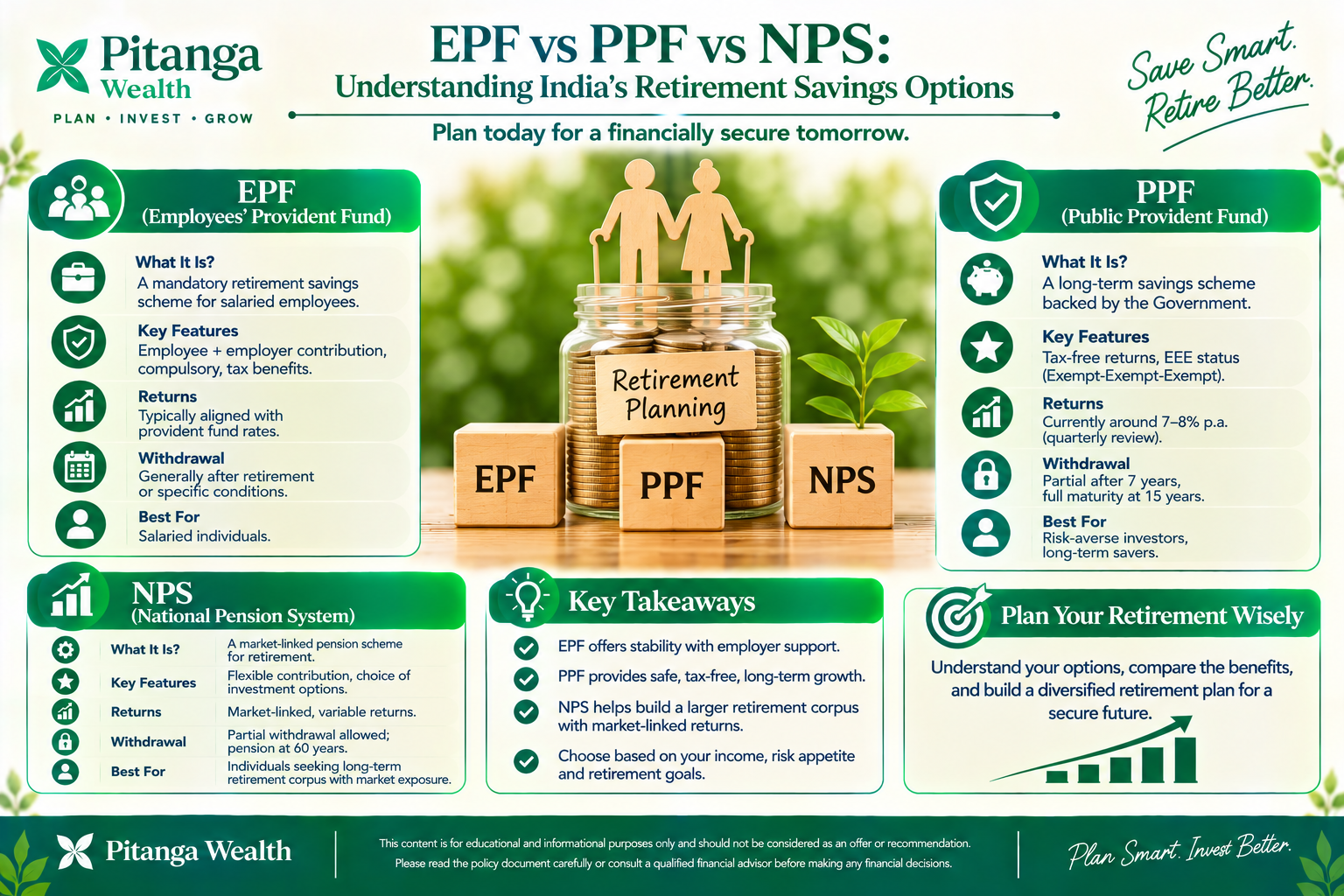
A retirement plan in India often begins with a familiar abbreviation: EPF on a salary slip, PPF at a bank or post office, or NPS on a pension-account dashboard. All three are long-term saving arrangements, but they solve different problems. EPF is a workplace-linked provident fund for eligible employees. PPF is a government-backed small-savings account with regulated interest and deposit limits. NPS is a pension-building framework in which investments and eventual withdrawal or annuity decisions depend on the applicable subscriber category and rules. Treating the three as interchangeable can produce unrealistic expectations about liquidity, tax deductions and retirement income. [1][2][3]
This EPF vs PPF vs NPS guide compares their purpose, access, contributions, risk, return mechanisms, maturity, exit rules and tax treatment. It reflects official EPFO, National Savings Institute, PFRDA and Income Tax Department information reviewed on 27 November 2026. The examples are fictional and educational. They are not a recommendation to join a particular scheme or an estimate of future investment returns.
Quick Answer: What Is the Difference Between EPF, PPF and NPS?
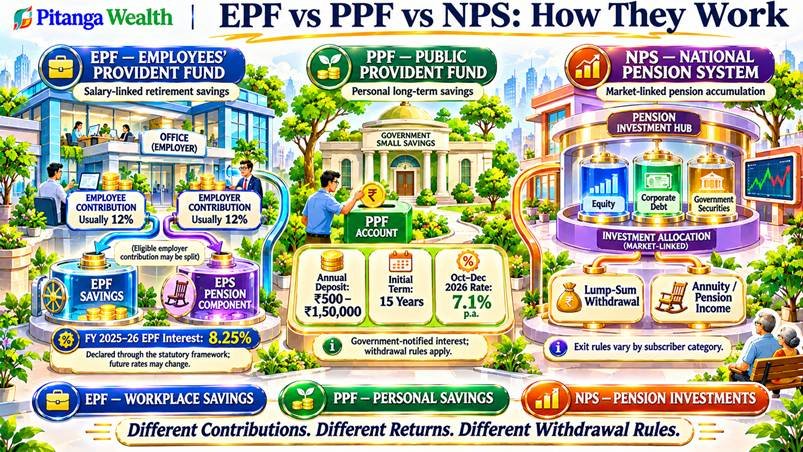
EPF ordinarily grows through salary-linked employee and employer contributions, with interest credited under the notified EPF framework; the employer’s payment may be split between EPF and the Employees’ Pension Scheme (EPS). PPF accepts eligible personal deposits, ordinarily between ₹500 and ₹1.5 lakh per financial year, and earns a government-notified interest rate that can change over time. NPS uses contributions invested through approved pension-fund options, meaning the account value can move with markets. Its normal-exit, partial-withdrawal and annuity requirements are not the same for all subscribers. [1][2][3]
The practical EPF vs PPF vs NPS question is not simply ‘which has the highest return?’ Start by asking whether the person is a covered salaried employee, how long their money can remain committed, whether predictable interest or market-linked growth is appropriate, and how their chosen tax regime changes the benefit of making a contribution.

Why Three Retirement Products Exist
Retirement saving has several jobs
Retirement planning needs several forms of money. An emergency reserve covers near-term shocks. An investment portfolio can pursue long-term growth with market risk. A retirement-linked account can impose discipline, encourage regular contributions, or coordinate savings with an employer. The strongest plan may use several instruments for different purposes rather than treating them as substitutes for an immediately accessible savings account.
For a young salaried person, EPF may already be accumulating automatically while they work. PPF may offer a personally controlled, long-term debt-oriented savings option. NPS can introduce pension-specific investment and payout choices. But no account guarantees that the final combined corpus will cover 25 or 30 years of retirement spending. Inflation, healthcare, longevity, taxes and family obligations still need attention. [4]
Do not confuse EPF, EPS, GPF, PPF and NPS
EPF and EPS are related under the employee provident fund framework, but the provident-fund balance and eligibility for an EPS pension are separate concepts. General Provident Fund (GPF) is another arrangement for eligible government employees and is not the PPF discussed here. NPS is not a fixed-rate savings certificate, and its annuity is not identical to EPS benefits. A pension estimate must be checked against the exact membership, service and product rules rather than against the name of a retirement app.
EPF: The Salary-Linked Retirement Foundation
Who normally participates in EPF?
The Employees’ Provident Funds and Miscellaneous Provisions Act framework covers specified establishments and workers. EPFO reporting describes mandatory membership for covered employees within the applicable wage ceiling and separately identifies conditions for higher-paid employees, existing membership and employer arrangements. For a new worker, never infer eligibility solely from monthly take-home pay or from whether the employer markets itself as a startup. Check the salary break-up, employer coverage, UAN and provident-fund member record. [1]
An EPF record normally follows the worker through a Universal Account Number (UAN), subject to proper identification and service records. A job change should trigger a check of exit dates, linked member IDs, contributions and transfers. Keeping multiple old passbooks unexamined can make future claims, interest verification and service-history checks more difficult. [5]
What does ‘12% EPF contribution’ really mean?
The often-quoted standard rate is 12% of EPF wages for the employee and 12% for the employer, subject to statutory categories, wage ceilings and applicable exceptions. Importantly, the employer’s full 12% does not necessarily enter the EPF savings balance. In the common EPS-eligible structure, a portion of the employer contribution goes to the Employees’ Pension Scheme and the remainder enters EPF; exceptions and higher-pension scenarios require separate verification. [1]
Consider a fictional employee whose EPF calculation wages are ₹15,000 a month and for whom the standard EPS contribution split applies. Employee EPF contribution: ₹1,800. Employer’s total standard 12%: ₹1,800. Of the employer amount, approximately ₹1,250 can go to EPS and ₹550 to EPF, giving approximately ₹2,350 into the EPF savings component for that month. These are illustrative mechanics, not a payroll calculation for every worker. Administrative and insurance contributions are separate employer-side items and should not be counted as personal EPF deposits. [1]
How is EPF interest determined?
EPF interest is administered under EPFO’s statutory process, not quoted as a perpetual bank-style fixed-rate guarantee. The Central Board of Trustees recommended an 8.25% annual rate for FY 2025-26, and a later government approval communication authorised crediting at 8.25% for that financial year. This is a rate for a specified financial year, not a promise for all future years. Timing of credit entries and the interest calculation method should be checked through official EPFO records. [6][7]
Can you withdraw EPF money before retirement?
EPF is primarily long-term employment-linked saving. Certain advances and withdrawals are permitted under specified circumstances, with eligibility conditions, documentation, service requirements and processing rules. A job loss, medical need or housing event does not mean that the entire balance is always freely available on demand. Changes to EPFO claim processes also make old social-media checklists unreliable. Confirm the exact claim category and current conditions on the official EPFO portal before making a decision. [5]
What risks deserve attention?
EPF is not exposed to the same day-to-day unit-price movements as an equity-market-linked NPS allocation, but operational problems still matter: missing wages, employer non-compliance, incorrect date of joining, an inactive or mismatched UAN, incorrect nomination, and confusion between EPF and EPS balances. Withdrawals may also have income-tax consequences if the conditions for exemption are not met. A digital passbook is a record to reconcile, not a substitute for salary and employment documentation.
PPF: Long-Term Government Small Savings
How does a PPF account work?
The Public Provident Fund is a separate, individual small-savings account available under the relevant scheme’s eligibility rules. The broad contribution limits are ₹500 minimum and ₹1,50,000 maximum in a financial year. The ordinary account runs for a 15-year period calculated under the scheme rules, with options for extension. A bank or post office may operate the account, but the governing conditions come from the statutory PPF scheme. [2][8]
PPF is useful to understand as a government-administered, long-horizon savings instrument rather than as a short-term parking account. Eligible guardians may maintain accounts for minors subject to aggregate contribution restrictions; additional rules apply to non-resident status and other special cases. Investors should confirm the current scheme restrictions, not assume that any resident or non-resident can open or renew an account in the same manner.
How is PPF interest calculated?
PPF receives a rate notified by the Government for the relevant period; it is not a permanently fixed rate at account opening. For October-December 2026, the reported PPF rate is 7.1% per annum, unchanged from the preceding quarter. Interest is generally calculated for each calendar month using the lowest balance between the close of the fifth day and month-end, then credited annually under the scheme rules. The monthly timing of deposits can therefore affect credited interest. Always check the next quarter’s official notification rather than extending 7.1% into an indefinite future. [2][8][9]
When does PPF mature, and what about withdrawals?
The initial account duration is ordinarily 15 years measured from the end of the financial year in which the initial subscription was made. There are prescribed routes for loans in early years, partial withdrawals from the applicable later year, and extensions after maturity, including five-year extension blocks with further deposits where properly elected. Premature closure is restricted to specified circumstances and can involve an interest adjustment. The existence of a withdrawal facility does not make PPF suitable for money needed next month. [8]
What does the tax treatment mean?
PPF has historically been described as an ‘exempt-exempt-exempt’ arrangement: eligible contribution deductions under the old tax regime, exempt interest and exempt qualifying withdrawals. The contribution deduction is not generally available to a person using the default new tax regime merely because the account remains tax-efficient. The detailed position depends on the tax year, account eligibility and current income-tax law. The PPF deposit maximum of ₹1.5 lakh is also not an extra deduction on top of the overall old-regime Section 80C limit. [10]
NPS: Market-Linked Pension Accumulation
What is different about an NPS account?
The National Pension System provides a regulated pension framework with account and fund choices under the relevant sector model. Unlike PPF, its Tier I account does not promise an interest rate for each year. The value depends on contributions, investments, market returns and charges. A fund allocation with equities can experience losses; an allocation dominated by government securities or corporate debt may still experience bond-price movements and other risks. The risk of any actual portfolio follows its chosen scheme and permitted exposures. [3]
A Permanent Retirement Account Number (PRAN) helps identify the subscriber. Tier I is the retirement-focused account; Tier II is a distinct, generally more flexible account subject to its own eligibility and tax treatment. Do not assume Tier II investments receive all of the same tax incentives or withdrawal restrictions as Tier I. The upcoming Pitanga Wealth NPS-specific guide explores the finer detail of tiers and subscriber options.
The important 2026 normal-exit update
A major point in the EPF vs PPF vs NPS comparison is that a single ‘60% lump sum and 40% annuity’ rule no longer describes every NPS subscriber. PFRDA’s exit regulations, last amended 20 July 2026, distinguish government and non-government sectors, types of exit, tenure, age and accumulated pension wealth. In the non-government sector, qualifying normal exits can permit up to 80% as a lump sum with at least 20% directed to an annuity when the applicable corpus thresholds and conditions are met. Special alternatives exist at certain smaller corpus sizes. Government-sector exits can retain a 60%/40% structure for larger corpus amounts. Early exits have different limits. [3][11]
Crucially, a regulator permitting an 80% withdrawal does not by itself mean that the entire 80% is income-tax exempt. Published NPS tax guidance continues to identify a statutory exemption for eligible retirement lump-sum withdrawals up to 60% of the accumulated corpus, subject to the applicable law. The treatment of any amount beyond the exempt limit must be verified under current law before an exit. Do not present an 80% permitted withdrawal as ‘80% tax-free’. [10][12]
Are annuity payments the same as guaranteed NPS returns?
No. The NPS account builds an invested corpus; a subscriber may use part of that corpus to acquire an annuity under the applicable exit rules. Once purchased, the annuity’s payout depends on provider terms, purchase amount, payout option, age and other relevant factors. Annuity income may be taxable when received. An illustration of ₹10 lakh at a fictional 6% annual payout would suggest ₹60,000 a year before tax, but that illustration is not an actual available annuity quotation and says nothing about inflation protection or whether capital is returned to nominees.
Contributions, charges and portability
NPS contributions can be personal, employer-supported or sector-linked depending on the account. Recordkeeping, account service, fund-management and other charges can affect long-term accumulation. A job change does not automatically mean abandoning an NPS account, but the transition between employer and individual models requires accurate record updates. Review PRAN, nominee, contribution and chosen allocation details directly through authorised channels. [3]

EPF vs PPF vs NPS: Side-by-Side Comparison
| Feature | EPF | PPF | NPS (Tier I) |
| Primary purpose | Workplace provident-fund savings | Personal long-term small savings | Pension-oriented market-linked accumulation |
| Usually accessible to | Eligible employees in covered arrangements | Eligible individuals under PPF rules | Eligible subscribers under NPS sector models |
| Funding mechanism | Employee and employer; EPS split may apply | Investor’s own deposits | Subscriber and/or employer contributions |
| Return mechanism | Statutorily declared interest for relevant FY | Government-notified interest for relevant period | Investment returns vary with chosen funds |
| Market-value movement | Not a directly quoted equity fund balance | Not a market-priced fund unit | Yes, depending on allocation |
| Typical time restriction | Employment and claim-rule dependent | Initial 15-year term; scheme-based facilities | Pension-account exit and withdrawal conditions |
| Contribution limit | Wage and scheme-rule based | ₹500-₹1.5 lakh per FY | Depends on scheme and tax/operational rules |
| Retirement cash flow | EPF lump sum and separate EPS eligibility | Maturity/extended-account withdrawals | Lump sum and possibly annuity under exit rules |
| Tax assessment | Contributions, interest, service and withdrawal conditions | Tax regime affects contribution deduction | Tax regime, account type and exit rules matter |
The table is a decision aid, not a universal suitability ranking. In particular, the NPS column summarises Tier I for a general reader; government, non-government, NPS-Lite, UPS-related and other permitted arrangements have sector-specific rules. EPS benefits under an EPF-linked employment record must not be inferred from an EPF closing balance. [1][3]
Tax Benefits: Why the Chosen Tax Regime Matters
Under the old tax regime
Eligible employee EPF contributions and PPF deposits may form part of the aggregate Section 80C deduction limit, subject to applicable conditions. Personal NPS Tier I contributions may be eligible under the relevant Section 80CCD provisions, including an additional deduction historically capped at ₹50,000 under Section 80CCD(1B), subject to law and eligibility. This additional deduction is not an automatic extra ₹50,000 cash benefit: a deduction reduces eligible taxable income, and its tax value depends on the taxpayer’s rates and circumstances. [10]
Under the new tax regime
The default new tax regime restricts many personal deductions available under the old regime. In particular, it generally does not allow the standard personal Section 80C or Section 80CCD(1B) deduction merely because someone funds EPF, PPF or NPS. Eligible employer NPS contributions may still qualify for a deduction under the relevant employer-contribution provision; the Income Tax Department’s AY 2026-27 guide lists a 14% salary limit for all employer categories under the new regime. This must be assessed alongside employer compensation design and aggregate contribution taxation rules. [10]
Tax treatment on exit can be different from tax treatment on entry
A person may make a PPF contribution without an old-regime deduction but still benefit from the product’s legally prescribed interest treatment. EPF withdrawals can have tax implications where continuous-service requirements and other exceptions are relevant. NPS lump-sum exemption, annuity purchase and taxable annuity income must be analysed separately. Finally, income-tax legislation and section mapping can change: verify the provisions applicable to the tax year being reported and the actual exit date instead of relying on an archived online calculator.
Worked Example 1: Comparing Contributions Without Predicting Returns
Imagine a fictional eligible salaried employee with EPF calculation wages of ₹15,000 per month and the standard contribution structure described earlier. Their monthly employee EPF contribution is ₹1,800 and the employer also contributes ₹1,800 into the relevant EPF/EPS framework. The employee could separately choose to deposit ₹3,000 each month into PPF, if eligible, and contribute ₹2,000 a month to NPS Tier I.
| Savings channel | Illustrative monthly amount | Illustrative annual amount |
| Employee EPF | ₹1,800 | ₹21,600 |
| Employer contribution across EPF/EPS | ₹1,800 | ₹21,600 |
| Personal PPF deposit | ₹3,000 | ₹36,000 |
| Personal NPS Tier I deposit | ₹2,000 | ₹24,000 |
| Total contributions across listed channels | ₹8,600 | ₹1,03,200 |
The annual total is simple arithmetic: ₹21,600 + ₹21,600 + ₹36,000 + ₹24,000 = ₹1,03,200. It is not the amount that all enters a single investment portfolio, nor is every rupee of the employer’s contribution a credit to the personal EPF savings balance. A portion may fund EPS. No return, pension benefit, tax saving or retirement corpus has been estimated in this example.
This EPF vs PPF vs NPS example shows why payroll records, PPF passbooks and NPS statements should remain separate even when the investor uses one spreadsheet to review retirement preparedness.
Worked Example 2: Retirement Income Is Not the Same as Corpus
Suppose another fictional person estimates essential retirement spending of ₹50,000 per month at retirement in future rupees, or ₹6 lakh for the first year. They have ₹25 lakh in EPF, ₹15 lakh in PPF and ₹20 lakh in NPS at that point, for a combined headline amount of ₹60 lakh. These numbers are invented and assume no real product statement.
The ₹60 lakh headline does not mean all ₹60 lakh can immediately be withdrawn under identical conditions or used to fund a flat monthly pension. EPF withdrawal eligibility, PPF maturity status and NPS sector-specific exit/annuity requirements matter. Taxes may differ across components; the NPS annuity portion may create future taxable payments instead of immediate free cash. A realistic spending plan also considers inflation and whether any household benefits or liabilities remain. Retirement calculators that multiply a single corpus by a constant payout percentage overlook these distinctions.
Choosing a Retirement Savings Mix Without Chasing a Winner
Case A — A young salaried employee
Start by verifying EPF employment coverage and salary deductions. Confirm whether the employer is crediting contributions correctly, whether EPS applies and how those savings sit alongside an emergency reserve. Additional voluntary PPF or NPS contributions should follow the person’s liquidity needs, debt obligations, time horizon and risk capacity. A long working life does not justify putting all accessible savings into locked retirement products.
Case B — A self-employed professional
A person without current EPF-eligible employment may consider PPF or voluntary NPS according to eligibility and suitability. The absence of an EPF salary deduction does not create an automatic retirement gap equal to somebody else’s employer contribution: it creates a need to plan and fund retirement saving independently. Reserve cash for uneven income, taxes and business needs before choosing long lock-ins. [2][3]
Case C — A worker approaching retirement
Review the expected dates, not just account balances. EPF claim eligibility, service-linked pension entitlements, PPF maturity and NPS exit category need separate confirmation. Ask what proportion will be accessible, what must support lifetime income and what cannot be relied on for early medical or housing expenses. Tax decisions around NPS and employment-linked payouts may be significant and should be reviewed with a qualified adviser when needed.
Case D — A person under the new tax regime
Avoid comparing tax-saving advertisements without checking the chosen regime. A PPF deposit may retain a long-term savings function even without a personal Section 80C deduction. A corporate NPS arrangement can still have employer-contribution considerations. For someone whose cash flow is constrained, the correct question is which savings commitment they can maintain, not which product carries the largest headline deduction.
Seven Checks Before Choosing or Increasing Contributions
1. Confirm eligibility. Verify employment, residency, age, account-category and product-specific requirements directly with the authorised institution.
2. Separate retirement from emergency money. Keep accessible reserves for near-term needs rather than treating early withdrawal facilities as cash substitutes.
3. Understand contributions. On an EPF payslip, distinguish employee PF, employer PF and EPS; in PPF and NPS, confirm personal and employer funding where applicable.
4. Check how returns arise. Annual interest declarations, government-notified rates and market-valued pension investments are not the same mechanism.
5. Match access to the actual goal. Compare EPF withdrawal conditions, PPF’s initial term and NPS’s exit category, annuity obligations and payout choices.
6. Verify tax rules for the relevant year. Distinguish tax deductions on contributions from treatment of accumulated interest, lump sums and annuity income.
7. Reconcile your records. Retain official EPFO passbooks, PPF account statements, NPS contribution statements, nominations and claim confirmations.
For a useful EPF vs PPF vs NPS review, note why each account is held, the contribution expected over the next year, access restrictions, beneficiaries, and the action required if employment or personal circumstances change.
Common Mistakes in Retirement Product Comparisons
Treating the highest recent interest rate as the best product
EPF interest and PPF interest apply to different product frameworks and time periods; NPS investments are market-linked. A rate printed next to an EPF or PPF headline does not establish the future value of a different product with different cash-flow timing. Compare retirement needs and access rules before comparing annual numbers.
Calling all employer contributions ‘EPF savings’
A standard employer contribution may be split across EPF and EPS. EPS is not simply a cash pocket within the employee’s EPF passbook. Calculating a retirement corpus by putting the entire employer 12% into a PF compound-interest formula can overstate the savings account balance. [1]
Describing 80% NPS lump sum as tax-free
The 2026 PFRDA non-government normal-exit rules can allow up to 80% as a lump sum under relevant conditions, but statutory exemption information must be assessed separately. Regulations about withdrawal permission and income-tax exemptions do different jobs. This distinction is crucial in any current EPF vs PPF vs NPS comparison. [3][12]
Ignoring early-exit rules and successor planning
Accounts with long maturities can be valuable for discipline but awkward for unexpected family needs. Different products also have different nominee, survivor and claim procedures. Do not assume that a nominee can trade, redeem or receive an identical entitlement under EPF, PPF and NPS without formal claims.
Where to Check Your Records and Raise Complaints
For EPF, use genuine EPFO member and employer channels to inspect UAN, service history, contributions and complaints. For PPF, obtain the relevant bank or post office’s official transaction history and scheme information. For NPS, check statements, fund allocation, the linked CRA or point of presence and the grievance route under PFRDA’s framework. Do not share OTPs, UAN passwords, PRAN credentials or full personal identification documents with a person claiming on WhatsApp that they can ‘release’ retirement money. [3][5]
If a contribution is missing, collect payroll or bank proof, the statement period, transaction reference and a written complaint number before escalating through the proper regulated channels. An agent’s screenshot is not independent proof of an account balance or a completed transfer.
Frequently Asked Questions: EPF vs PPF vs NPS
1. What is the main difference between EPF, PPF and NPS?
EPF is primarily employment-linked saving for eligible workers, PPF is a personal government small-savings scheme, and NPS is a regulated pension framework with market-linked investments and defined withdrawal/annuity rules. Eligibility, access and taxation differ; none replaces a complete retirement plan.
2. Can one person hold EPF, PPF and NPS together?
Yes, a person may be eligible to participate in all three at the same time. Their accounts remain legally and operationally separate. Overall affordability, PPF deposit limits, payroll contributions and tax rules should be reviewed rather than counting each product as an independent tax deduction.
3. Is EPF mandatory for every salaried employee?
No. Coverage depends on the employer, statutory framework, wages, existing membership and any applicable exceptions. The correct answer comes from the employer’s status, payroll and EPFO account records, not just the job title or take-home salary. [1]
4. Does the employer’s entire 12% contribution enter EPF?
Not necessarily. Under the standard EPS-eligible arrangement, part of the employer’s contribution is diverted to EPS and the remaining portion enters the EPF savings account. Individual treatment can differ. Review the actual passbook and pension service record. [1]
5. What is the PPF annual deposit limit?
Under the PPF scheme, the ordinary permitted range is ₹500 to ₹1,50,000 per financial year, subject to aggregation and eligibility rules. The deposit ceiling is not an extra deduction in addition to the overall old-regime Section 80C limit. [2]
6. What is the PPF interest rate in late 2026?
The rate for the October-December 2026 quarter is 7.1% per annum. It is a notified rate for that period rather than a guaranteed interest rate for every remaining year of a 15-year account. [9]
7. What was the EPF interest rate for FY 2025-26?
The relevant EPFO process recommended 8.25%, and a subsequent government approval communication authorised crediting that rate for FY 2025-26. The rate can change in other financial years. [6][7]
8. Is NPS safer than EPF or PPF?
The products carry different types of risk. PPF’s structure and EPF’s credited-interest framework are unlike an NPS portfolio exposed to market-value changes. But eligibility, inflation, institutional operations, liquidity and the real value of retirement income matter in every case. ‘Safer’ requires a specific risk definition.
9. Can NPS subscribers withdraw 80% on retirement?
Qualifying non-government normal exits may permit a lump-sum withdrawal up to 80% under current PFRDA rules, subject to category, age, tenure and corpus conditions. Government-sector and premature-exit rules differ. The tax exemption on withdrawal is a separate question. [3][11]
10. Is the full 80% NPS lump sum tax-free?
Do not assume so. Public NPS income-tax guidance historically identifies tax exemption on an eligible lump sum up to 60% of accumulated pension wealth. The legal treatment of any additional permitted withdrawal should be checked under the law applying at exit. [12]
11. Does PPF provide a monthly pension after maturity?
PPF is a small-savings account, not an automatic annuity or defined monthly pension. On maturity or extension it is handled under PPF withdrawal and account-continuation rules. A household seeking monthly retirement income needs a separate spending and payout plan. [8]
12. Can self-employed people use EPF, PPF and NPS equally?
No. EPF is tied to covered employment arrangements; self-employed individuals may instead be eligible for PPF or NPS depending on their circumstances. Tax and liquidity considerations are especially important for variable business income.
13. Are personal PPF and NPS contributions deductible in the new tax regime?
Personal Section 80C and Section 80CCD(1B) deductions are generally unavailable in the new regime. Eligible employer NPS contributions may still qualify under the applicable employer-contribution provision. Tax treatment should be checked for the actual assessment year and compensation arrangements. [10]
14. Which is best for retirement: EPF, PPF or NPS?
There is no universally best product. A covered salaried employee may already receive EPF contributions; someone valuing a long-term government savings component may assess PPF; an eligible investor comfortable with a market-linked pension framework may evaluate NPS. The decision depends on income, costs, risk, access, tax regime and retirement needs, not an advertised return ranking.
Conclusion: Build a Retirement Plan, Not a Product Ranking
The meaningful EPF vs PPF vs NPS decision is about combining or selecting appropriate savings mechanisms under real financial constraints. EPF links retirement accumulation to eligible employment and may include a separate EPS pension component. PPF offers rule-based, government-administered long-term savings. NPS introduces market-linked accumulation and pension-exit choices whose 2026 rules must be read by subscriber category. Taxes and liquidity can change the practical outcome even when account balances look similar.
Before adding money, confirm your retirement horizon, monthly saving capacity, emergency reserve and any employer benefits. Use verified EPFO, PPF and NPS records; review beneficiary details; and compare after-tax, accessible retirement resources instead of assuming each nominal balance is immediately spendable. An informed plan also revisits inflation, healthcare spending and the intended retirement income arrangement.
Disclaimer
This article is general investor education prepared for Pitanga Wealth. It is not personalised investment, pension, employment, legal or tax advice and does not recommend an EPF, PPF, NPS account, pension fund, annuity or allocation. Illustrations, contributions and payout assumptions are fictional. Scheme membership, rates, tax benefits, age limits, withdrawals, sector-specific NPS rules and income-tax provisions may change. Official sources were reviewed on 27 November 2026. Readers should confirm current rules with the relevant administrator and seek qualified guidance for personal circumstances. Investments in market-linked NPS options can lose value; no retirement income or return is guaranteed.
Written by Pitanga Wealth Team.
Follow us on Instagram @pitangawealth for more educational insights.
This article is for educational and informational purposes only. It is not investment, tax, legal or insurance advice. Consider your circumstances and relevant documents before making a financial decision.