

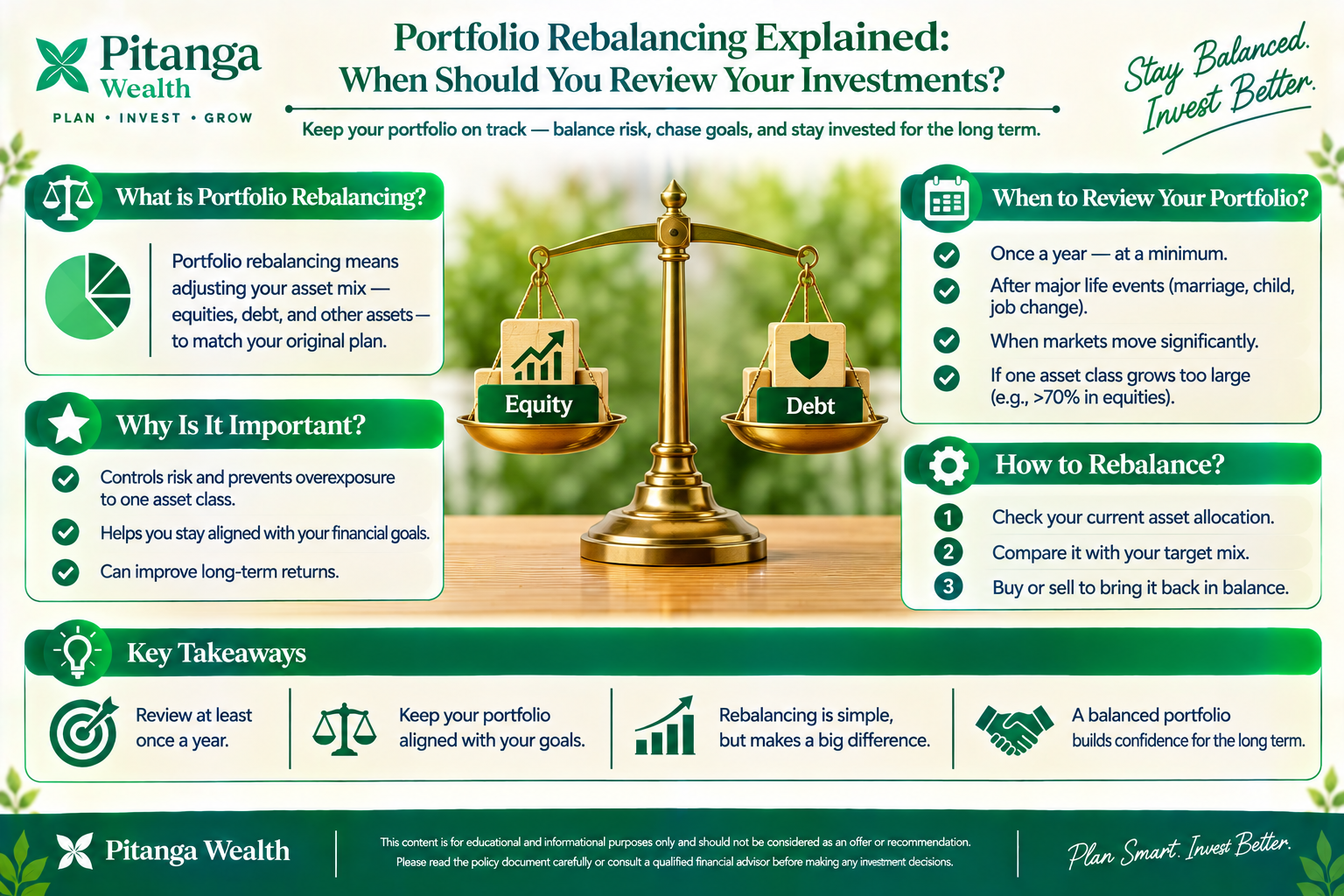
An investment portfolio can change even when its owner does nothing. Shares, debt instruments, gold, cash and mutual funds do not move in exactly the same way. As their values change, the relative weight of each asset class changes too. Meanwhile, the investor may change jobs, approach retirement, need money for education, or discover that market losses feel harder to tolerate than expected. A portfolio designed several years earlier may no longer fit its purpose.
The practical question is therefore not simply “How often should I rebalance?” It is “What should I review, what would justify changing anything, and how can I avoid unnecessary transactions?” Portfolio rebalancing in India is best understood as a disciplined risk-management process, not a technique for identifying the next winning asset class. This guide explains the decision process with fictional Indian-rupee examples and official investor-education references reviewed on 26 November 2026. It does not prescribe any asset allocation or transaction for an individual reader. [1][2]
Quick Answer: When Should You Review Your Investment Portfolio?
Review your investment portfolio on a planned schedule and after meaningful changes in your goals, cash needs or ability to bear risk. An annual, documented full review is a practical educational example; some investors also monitor broad allocation drift at shorter intervals. Rebalance only when the current allocation has moved sufficiently away from a suitable target, or when the target itself needs reconsideration. A contribution, withdrawal or planned cash flow may correct the mismatch without selling. There is no SEBI rule requiring every retail investor to rebalance every quarter, year or at a particular percentage threshold. [1]
The three decisions are different: review means checking the facts; reassess means deciding whether the plan remains appropriate; and rebalance means adjusting holdings to implement an appropriate target. Markets moving by themselves do not create a legal or mathematical obligation to trade.
Portfolio Review vs Portfolio Rebalancing: What Is the Difference?
A review is a diagnosis, not a transaction
A useful portfolio review looks at current asset values, allocation percentages, goals, liquidity, product risks, costs and actual records. It can conclude that no change is needed. It may also reveal a missing account statement, an unexpected scheme-risk change, overlapping funds, an approaching goal or a large equity overweight. The outcome should follow the evidence, not a headline about the Sensex or a social-media recommendation.
Portfolio rebalancing is narrower: it restores—or moves toward—a chosen mix of assets after the mix has drifted. The target might be 60% equity and 40% debt, but those figures are only illustrations. The appropriate target depends on time horizon, income stability, risk capacity, debt obligations, liquidity needs and the assets actually available to the investor. SEBI’s investor resources emphasize goals, time horizon, risk appetite, diversification and monitoring rather than a universal fixed allocation. [1][2]
Changing the target is not the same as restoring it
Imagine that an investor originally chose a 70:30 equity-to-debt mix for a distant retirement date. If retirement is now close and the person needs more dependable near-term liquidity, the right question may be whether the old target still suits the goal. Selling enough equity to restore 70:30 might mechanically satisfy a spreadsheet while ignoring a material change in circumstances. A genuine review begins with the goal; the target follows.
Why Portfolio Allocations Drift Without Any Trading
A portfolio’s allocation is each asset class’s current value divided by the combined value of the relevant investment portfolio. It is not determined by the original money invested. Price changes, interest accruals, distributions, fresh contributions and withdrawals can all affect the mix. A share market rally can increase the weight of equity; an equity decline can make debt or cash appear larger as a percentage even if that asset has not increased.

A simple 60:40 illustration
Consider a hypothetical investor who starts with ₹10,00,000: ₹6,00,000 in equity exposures and ₹4,00,000 in debt exposures. After an unspecified period, assume equity is worth ₹7,80,000 and debt is worth ₹4,20,000. The portfolio is now ₹12,00,000. The weights are 65% equity and 35% debt. The shift has occurred without an intentional change to the original plan. These values are fictional, do not represent actual returns and exclude tax and transaction costs.
| Measure | Equity | Debt | Total |
| Original value | ₹6,00,000 | ₹4,00,000 | ₹10,00,000 |
| Original weight | 60% | 40% | 100% |
| Illustrative current value | ₹7,80,000 | ₹4,20,000 | ₹12,00,000 |
| Current weight | 65% | 35% | 100% |
For portfolio rebalancing, whether five percentage points of drift warrants action depends on the investor’s written policy, risk capacity and potential trading costs. It is not a regulatory threshold or an automatically suitable number for everyone. Small valuation differences can also arise from statements dated on different days; reconcile the inputs before interpreting the difference as meaningful.
How Often Should Investors Review Their Investments?
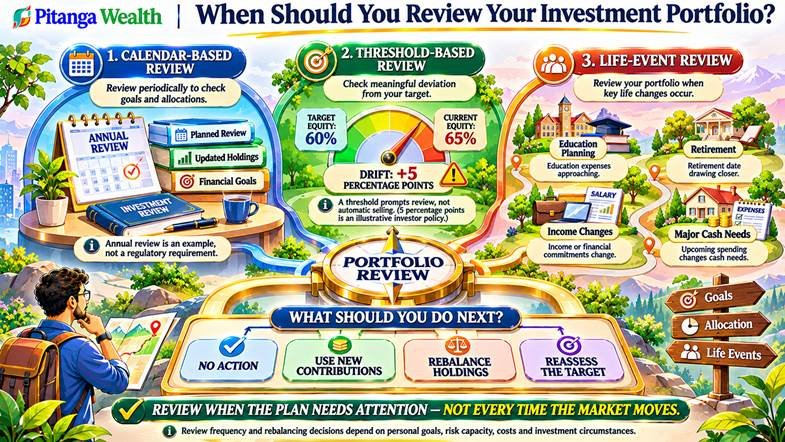
Scheduled reviews: a calendar that is easy to maintain
A planned yearly review can bring together investments, taxes, major goals and insurance or emergency-fund changes. A shorter monthly or quarterly glance at account alerts and broad exposure may catch errors or serious mismatches earlier. These are examples of useful routines, not a prescribed schedule. Monitoring is not the same as automatically switching schemes or redeeming units. Checking too frequently can encourage emotionally driven action; checking too rarely can allow a portfolio to drift unnoticed.
Threshold reviews: focus on how far the portfolio has moved
Some investors define an allocation band in advance: for example, investigate when equity moves five percentage points away from a 60% target. Under this *illustrative* policy, an equity weight of 65% would prompt review. The review might still conclude that selling today is unwise because the deviation is temporary, the account data is incomplete, a future contribution can correct it, or the tax and exit-load costs are material. A threshold is a decision prompt, not a command to transact. It should not be selected by copying someone else’s risk tolerance.
Event-driven reviews: sometimes the date matters less than life
A change in income, a house purchase, caregiving obligations, school or university fees, a large medical expense, approaching retirement, a change in tax residency, or a substantial withdrawal can all justify a review sooner than the next calendar date. So can a material change in a product’s stated mandate, risk, costs or liquidity. SEBI explicitly encourages portfolio reviews at significant milestones, including marriage, children and retirement. [1]
| Review trigger | Question to ask | Automatic trade? |
| Planned annual review | Do goals and current weights still agree? | No |
| Allocation moves outside policy band | Is drift meaningful after checking records? | No |
| Goal is approaching | Should the risk target or liquidity plan change? | No |
| Major income or family change | Has ability to absorb a loss changed? | No |
| Scheme or product change | Is the original holding rationale still valid? | No |
| Large contribution or withdrawal | Can cash flows restore the mix? | No |
Seven Essential Checks in a Portfolio Review
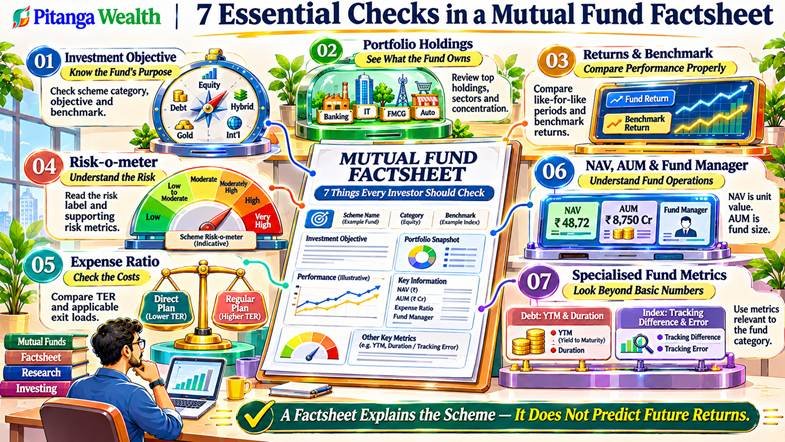
Check 1 — Confirm what each pool of money is for
Label the goal before examining returns: retirement, education, a planned home purchase, or an emergency reserve. Separate money required soon from money intended to remain invested for many years. A single allocation across all assets can hide the fact that some money has a very different time horizon. An emergency fund is primarily about access and resilience; it should not be forced into the same risk policy as a distant retirement portfolio. [2][3]
Check 2 — Recalculate current asset-class weights
List every relevant account at a comparable valuation date. Include direct shares, mutual fund exposures, ETFs, bonds and other eligible investment holdings. Review what a hybrid or multi-asset scheme actually holds rather than placing its entire value under “equity” merely because it appears inside an equity-oriented app menu. Do not count the same underlying holding twice when a dashboard and a depository statement both display it.
Check 3 — Compare with a written target and tolerance band
Write down the chosen allocation and why it fits the goal, rather than relying on remembered percentages. Compare target and actual percentages and identify the largest differences. If no suitable target has ever been established, “rebalance to 60:40” is not the first task; understanding a suitable risk budget is. Asset allocation cannot guarantee returns or eliminate market-wide risk. [1][2]
Check 4 — Revisit risk capacity and remaining time
Risk capacity is not the same as willingness to watch prices fluctuate. Someone may be emotionally comfortable with volatility but need funds for an imminent expense; another person may have a long horizon yet face uncertain income or high-cost debt. Changes in dependants, debt, emergency reserves and employment security should influence the review. Avoid assuming age alone dictates one precise equity percentage.
Check 5 — Inspect liquidity, costs and restrictions
Check what can actually be redeemed or transferred, how long proceeds may take, applicable exit loads, lock-in provisions, trading spreads, transaction fees and any pledge or restriction. Liquid-looking balances are not always withdrawable cash. Retirement-linked and tax-saving products may have specific rules, while a mutual fund redemption differs operationally from selling a listed share. Read current product documents before acting. [4][5]
Check 6 — Understand tax consequences before trading
Estimate which investments would be sold, the cost and acquisition date of those units, and the possible taxable gain or loss under the rules applying to that asset and investor. Equity shares, equity-oriented mutual funds, specified mutual funds and other assets can have different rules. A mutual fund switch-out generally operates as a redemption and switch-in as a purchase; it should not be treated as a universally tax-free internal transfer. Tax effects can be important even when a transaction is described as “moving money” rather than “selling.” [5][6][7]
Check 7 — Document a small, reviewable action plan
Write down what changed, the target considered, the chosen response and the reason. Possible decisions include doing nothing, redirecting a future SIP, using an upcoming withdrawal from an overweight asset, making a limited sale, or obtaining qualified advice for a complex case. Note the intended execution period and when to check the resulting statements. A decision record reduces the temptation to reverse course every time markets move.
Worked Example: How Much Would a Rebalance Require?
For a portfolio rebalancing calculation, return to the fictional ₹12,00,000 portfolio with ₹7,80,000 equity and ₹4,20,000 debt. Suppose, only for this worked example, that the 60:40 target remains suitable and no tax, spread or fee is included in the arithmetic. The target amounts at the same total value are 60% × ₹12,00,000 = ₹7,20,000 in equity and 40% × ₹12,00,000 = ₹4,80,000 in debt.
| Item | Before review | Illustrative target | Difference |
| Equity | ₹7,80,000 | ₹7,20,000 | −₹60,000 |
| Debt | ₹4,20,000 | ₹4,80,000 | +₹60,000 |
| Total | ₹12,00,000 | ₹12,00,000 | ₹0 |
One way to restore the assumed target would be to reduce equity by ₹60,000 and increase debt by ₹60,000. This is a *gross arithmetic illustration*, not a recommendation to sell. Real-world tax, exit loads, price movement, NAV timing and other transaction costs can change both the amount and the result. Rounding and fractional units can also make the precise target impossible to reach with one order.
Rebalancing with new money instead of a sale
There is a second hypothetical route. If the investor plans to contribute ₹1,00,000 and puts all of it into the underweight debt portion, equity stays at ₹7,80,000 and debt becomes ₹5,20,000. The new total is ₹13,00,000: precisely 60% equity and 40% debt. No existing equity holding needed to be redeemed in this simplified example. Directing contributions toward an underweight allocation can reduce the need for taxable sales, although the new investment may still have its own applicable charges and the mix can shift again with market prices.
A person without ₹1,00,000 available should not invent fresh cash just to hit a ratio. The practical options are to move toward the target gradually, use scheduled contributions or withdrawals, tolerate temporary drift within policy, or reassess whether an actual sale is warranted. The right choice weighs risk reduction against costs and cash needs.
Portfolio Rebalancing Methods: Which Ones Are Worth Understanding?
New contributions, SIP adjustments and cash flows
A future contribution can be directed toward the underweight asset class. An existing SIP allocation may be reconsidered, but changing the destination of future payments does not retroactively change current holdings. An SWP or planned withdrawal can sometimes be taken from an overweight exposure, subject to redemption rules and personal liquidity needs. Keep a proper record of each change; “my SIP is diversified” does not prove that the full portfolio remains balanced.
Selling overweight holdings and purchasing underweight ones
This method can restore the target more quickly, especially if the portfolio is much larger than future savings. It can crystallize gains or losses and may produce exit loads or brokerage costs. It also temporarily alters exposure while orders and settlements are processed. Verify quantities and the correct account; do not assume a single click in an investing app produces simultaneous settlement across unrelated products.
Switching mutual fund schemes
A switch between mutual fund schemes or plans should be examined as a redemption from one investment and an application to another under the scheme’s transaction rules. AMFI explains separate switch-out and switch-in treatment for applicable NAV determination. The value of units allotted can depend on processing and cut-off conditions, not simply the figure shown on the instruction screen. A switch is not a special mechanism that automatically eliminates capital gains or exit loads. [5]
Annual, threshold and hybrid policies
A calendar policy schedules a review at a predictable time. A threshold policy initiates a review after a preselected deviation. A hybrid policy combines a scheduled full review with an earlier investigation if major drift or a life event occurs. None has a universal superiority claim. The policy should be simple enough to implement consistently and should explicitly distinguish review frequency from trading frequency.
When Should the Target Asset Allocation Itself Change?
As the goal moves closer
A goal five years away does not necessarily tolerate the same short-term risk as a goal twenty years away. The investor may need to reduce uncertainty of money that must be spent on a definite date. This may lead to changing the intended allocation rather than merely rebalancing the old one. The appropriate process depends on spending flexibility, other income, inflation, pension access and the loss the goal can withstand. SEBI notes that investment choice should reflect the horizon and warns about volatility and illiquidity for near-term needs. [2]
Retirement: avoid a mechanical age-based formula
Retirement planning often involves different portfolios or “buckets” for near-term spending, medium-term needs and longer-term growth. The allocation may change as income sources, pension arrangements and withdrawal needs evolve. Some investors describe a deliberate change in target risk over time as a *glide path*. It is not the same as restoring an unchanged mix after market drift. A person retiring soon but supported by secure recurring income may have a different capacity for investment risk than another person of the same age relying heavily on withdrawals.
Changes in income, liabilities or family responsibilities
A job loss, lower expected earnings, new dependants or major borrowing can reduce resilience against a market decline. Conversely, a higher stable income or a reduction in essential liabilities may change the planning constraints. Neither automatically justifies a larger equity holding. Review cash flows and protections first; an emergency buffer is a separate concern from long-term allocation.
Product changes and concentrated exposures
A material change in scheme objective, risk profile, portfolio composition or fees can mean the original reason for owning an investment needs to be revisited. Multiple diversified-looking funds can still hold similar securities and sectors. The relevant measure is the combined exposure and the scheme mandate, not the number of app icons or folios. Mutual fund factsheets, SID/KIM documents and benchmark details are more useful than judging an investment only by its latest return. [3][4]
What Counts as Equity, Debt, Gold and Other Exposure?
An India-focused portfolio can contain listed shares, equity mutual funds, bond investments, fixed deposits, hybrid funds, gold products, cash holdings, retirement-linked assets and property. These assets differ in market risk, credit risk, liquidity, taxation and access. There is no single correct convention for including a family home, business ownership or employee provident fund balance in a short-term rebalancing worksheet. Use a consistent definition of the assets actually serving the relevant goal, with separately disclosed items whose values are not reliably observable or readily tradable.
A multi-asset or hybrid fund may have internal asset allocations; do not classify all its units as equity without checking the latest disclosure. An equity index fund still carries equity-market risk. A debt fund is not a bank fixed deposit, and “debt” is not synonymous with guaranteed value. Gold-related exposures can be volatile and may serve different purposes than an emergency reserve. Each product needs its own risk and liquidity review. [2][4]
Tax, Exit Load and Liquidity: Why a Perfect Ratio May Be Costly
Portfolio rebalancing arithmetic typically uses current market values and assumes frictionless transactions. Real life is different. Selling equity mutual fund units or shares can produce a taxable capital gain, even when the money is reinvested immediately. A mutual fund switch-out can be a realization event. Specific tax treatment depends on the applicable law, instrument classification, acquisition date, holding period and personal circumstances. Do not assume older capital-gains tax rates or thresholds are current merely because an investment was purchased under an earlier regime. [6][7]
Exit load is another separate issue. A scheme may charge an exit load for particular redemptions or switch-outs under its current terms; other schemes may have no such load for a transaction. Brokerage, securities transaction tax where applicable, bid–ask spread, stamp duty where relevant and operational constraints may also influence the result. A reader should compare the likely improvement in the portfolio’s intended risk alignment against the actual cost of each possible transaction. [4][5]
Tax-efficient does not mean tax-free. Nor does keeping an unsuitable portfolio forever merely to postpone a tax bill automatically make sense. The purpose is to avoid an unnecessary cost while maintaining an appropriate investment plan. Complex cases deserve an informed tax calculation and, if needed, professional advice rather than a one-line online rule.
Three Practical Review Scenarios
Scenario A — Markets rise, but the goal is unchanged
An investor notices the hypothetical shift from 60:40 to 65:35. They verify the values, confirm the target remains suitable, inspect transaction costs and decide that a planned future contribution can correct the mismatch. The important conclusion is not “equity is now expensive”; it is that the investor has made a deliberate decision about risk exposure using current information.
Scenario B — A parent needs education fees in two years
A family has a long-term investment pool and a separate amount earmarked for tuition. They discover the tuition portion is exposed to volatile investments despite a relatively near payment date. This is more than an allocation-drift problem. They need to revisit the spending date, certainty of the payment, suitable liquidity and the possibility of selling at an unfavourable price. No general 60:40 rule settles that question; the goal must lead. [1][2]
Scenario C — Retirement is approaching
A saver approaching retirement reviews expected pension income, emergency money, upcoming living expenses, family obligations and the risk of needing withdrawals during a market decline. The person may alter the long-term target, perhaps using a planned glide path, rather than keep mechanically restoring an allocation selected years before. The example illustrates the question, not a standard allocation recommended for retirees.
A Simple Portfolio Review Worksheet
Use the following as a recordkeeping aid, not an automatic trade instruction. Update it with genuine account statements and the same valuation date wherever practical.
| Worksheet field | What to record |
| Goal and date | Purpose of the invested money; expected spending window |
| Current portfolio value | Verified holdings and valuation dates |
| Target allocation | Written mix and reason for choosing it |
| Actual allocation | Weights by relevant underlying asset class |
| Drift | Actual percentage minus target percentage |
| Policy trigger | Review date, tolerance band or important life event |
| Constraints | Lock-ins, liquidity, tax lots, exit loads, transaction costs |
| Decision | No action, new cash flow, partial rebalance or new target |
| Follow-up | When to check execution and updated statements |
If several accounts are involved, use depository holding records and the Consolidated Account Statement (CAS) where applicable, together with mutual fund folio statements, broker trade records and bank movements. CAS is an oversight statement, not a substitute for tax-lot details or an investor’s personal plan. The mutual fund factsheet describes the scheme, not the investor’s complete household allocation.
Common Portfolio Rebalancing Mistakes
Rebalancing because an asset has recently performed well
Outperformance alone does not prove an asset is overvalued or must be sold. Rebalance to manage an intended allocation, not to make a disguised short-term market forecast. Equally, buying a lagging asset class just because it is down does not ensure a recovery.
Treating daily monitoring as disciplined investing
Checking a dashboard every day can create pressure to act. Review frequency should match the information that materially affects the goal. Maintain independent records and transaction alerts, but separate security monitoring from portfolio-trading decisions.
Looking at one mutual fund rather than total exposure
A fund can be diversified internally while the household portfolio remains heavily exposed to the same asset class, industry or market. Include meaningful overlapping holdings and use current factsheets to understand exposures.
Ignoring cash needs, restrictions and taxes
A target ratio that forces the sale of a locked-in or urgently needed investment may not be achievable. Calculate costs and available liquidity before an order. Avoid treating an app’s displayed “switch” as proof of tax exemption.
Using someone else’s ideal allocation
A percentage useful for one investor can be unsuitable for another person with a different horizon, liabilities or risk capacity. A written explanation of the chosen target is more informative than a social-media allocation rule.
Frequently Asked Questions About Portfolio Reviews and Rebalancing
1. What is portfolio rebalancing in simple words?
Portfolio rebalancing means adjusting holdings so the mix of investments moves back toward an intended asset allocation. It is primarily a process for managing unintended changes in exposure and risk, not a guarantee of higher returns.
2. How often should I review my investment portfolio in India?
There is no universal mandatory review frequency for retail investors. An annual full review is one practical approach, with earlier checks when major life changes or important allocation deviations occur. Reviewing does not necessarily require transacting.
3. Does SEBI require investors to rebalance every year?
No general SEBI rule requires every retail investor to rebalance annually. SEBI investor education encourages monitoring, reviewing goals and making suitable adjustments; it does not prescribe a universal annual transaction rule. [1]
4. What is the difference between asset allocation and rebalancing?
Asset allocation is the intended distribution across classes such as equity and debt. Rebalancing is the action of adjusting holdings toward that target after drift. A portfolio review may also conclude that the target itself needs changing.
5. Is a five-percentage-point drift always a reason to sell?
No. A five-percentage-point band is a hypothetical policy choice, not a universal standard. A breach may prompt review, but the appropriate decision also depends on goals, available contributions, taxes, transaction costs and account restrictions.
6. Does portfolio rebalancing improve investment returns?
It can change the pattern of risk and future outcomes, but it does not guarantee higher returns. In some market conditions a rebalanced portfolio may earn less than a portfolio left to drift. The primary purpose is maintaining a chosen risk exposure.
7. Can I rebalance using SIP contributions instead of selling?
Potentially yes. Directing future contributions toward an underweight asset can move the mix toward its target without selling existing holdings. The effect depends on contribution size, market movements and the target allocation.
8. Is switching between mutual funds tax-free in India?
Do not assume so. A switch-out is generally processed as a redemption and can trigger capital-gains consequences depending on the fund and tax rules. Check the relevant tax position, exit load and transaction treatment before switching. [5][6]
9. Should I include my emergency fund when rebalancing?
Money reserved for near-term emergencies serves a different purpose from long-term investments. It is often clearer to assess the emergency reserve separately and define the investment portfolio consistently, rather than force emergency cash into a risk-seeking target.
10. Should I rebalance after a stock-market crash?
A sharp decline may justify verifying the portfolio and reassessing risk capacity, but panic trading is not automatically appropriate. Check current weights, cash needs, the original plan and applicable costs before deciding whether any action is warranted.
11. What if I hold both mutual funds and direct stocks?
Review the combined exposure. A diversified mutual fund and direct shares can overlap in sectors or even individual companies. Rebalancing calculations should use an understandable asset-class view that avoids counting the same holdings twice.
12. Is retirement rebalancing different from ordinary rebalancing?
Retirement planning may involve changes to the target itself because of new income, spending and liquidity needs. Such a deliberate glide-path adjustment is different from merely restoring a fixed asset mix after market drift.
13. Should I sell everything that has performed well?
No. Strong performance is not by itself evidence that selling is appropriate. The review is about allocation, goals, risk and costs, not predicting which asset will rise or fall next.
14. What documents help me review and rebalance safely?
Relevant holdings and transaction statements, CAS where applicable, mutual fund factsheets and scheme documents, cost and acquisition records, bank movements and the written goal/allocation plan. Check dates and discrepancies before placing orders.
Conclusion: Review the Plan Before You Change the Portfolio
A useful portfolio review begins with a question about the investor’s goals, not a prediction about markets. It checks whether current holdings still reflect the chosen risk and liquidity needs. Rebalancing may then be justified by material allocation drift, but a review can also conclude that no action is needed, that future contributions should be redirected, or that a major life change calls for a new target altogether.
For Indian investors, the practical steps are to keep reliable records, compare real exposure with a reasoned target, look ahead to spending needs, and understand tax and transaction consequences before acting. Discipline is not the number of trades made. It is the quality of the decisions recorded and revisited over time. Portfolio rebalancing in India should support a financial plan—not substitute for one.
Disclaimer
This article is general investor education prepared for Pitanga Wealth and is not personalised investment, securities, financial-planning, tax or legal advice. It does not recommend a target asset allocation, security, mutual fund, product or trading strategy. All portfolio amounts, return paths, tolerance bands and examples are fictional illustrations, not forecasts. Actual suitability, taxes, exit loads, settlement, lock-in, liquidity and other consequences depend on the product, investor, timing and applicable laws. Mutual fund investments are subject to market risks; read all scheme-related documents carefully. Pitanga Wealth may provide educational information and appropriate distribution-related assistance; personalised investment advice should be sought from an appropriately authorised professional where necessary. Official source material was reviewed on 26 November 2026 and may change.
Written by Pitanga Wealth Team.
Follow us on Instagram @pitangawealth for more educational insights.
This article is for educational and informational purposes only. It is not investment, tax, legal or insurance advice. Consider your circumstances and relevant documents before making a financial decision.