

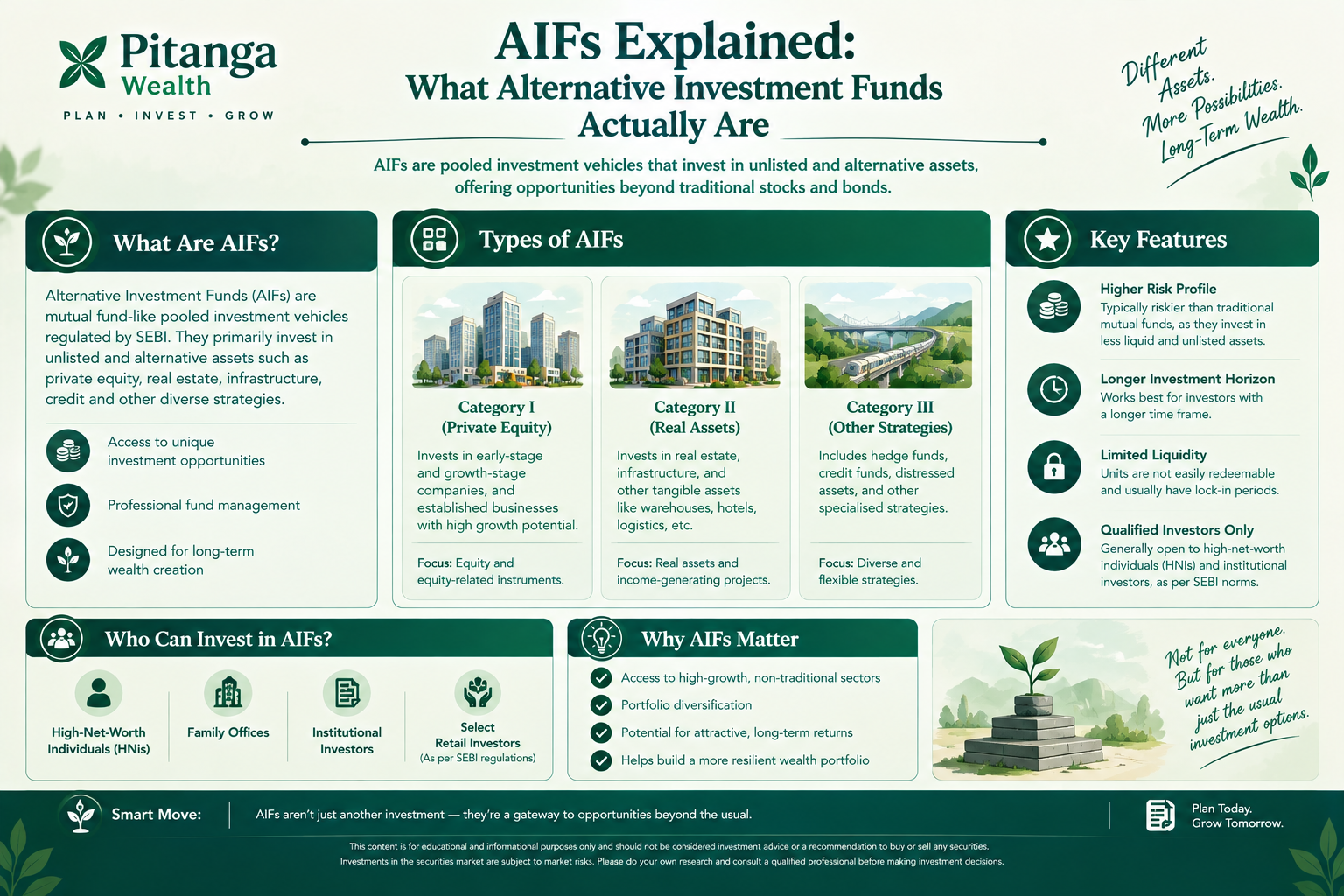
Alternative investment funds in India have become an increasingly discussed part of the investment landscape, particularly among investors exploring opportunities beyond conventional mutual funds and listed securities.
You may have come across terms such as private equity, venture capital, private credit, or hedge-fund-style strategies. These are often associated with Alternative Investment Funds, commonly called AIFs.
But what exactly is an AIF? How does it work? And does access to a different investment strategy necessarily mean better investment outcomes?
Not at all.
Alternative investment funds in India can offer exposure to specialised investment strategies, but they may also involve significant risks, limited liquidity, complex fee arrangements, and substantial capital commitments.
Let’s understand how these funds work, what separates their categories, and what investors should know before considering them.
What Are Alternative Investment Funds in India?
An Alternative Investment Fund, or AIF, is a privately pooled investment vehicle that collects capital from eligible investors and invests according to a defined investment policy.
In India, AIFs operate under the regulatory framework established by the Securities and Exchange Board of India (SEBI).
Unlike conventional mutual funds, AIFs generally cater to investors who can evaluate more complex investment structures and accept the associated risks.
Depending on their category and investment strategy, AIFs may invest in areas such as privately held businesses, venture capital opportunities, debt instruments, listed securities, or other permitted assets.
The term alternative does not mean that these investments are outside regulation or automatically more rewarding.
It refers to investment structures and strategies that differ from conventional investment products.
How Do Alternative Investment Funds Work?
Alternative investment funds in India pool commitments or contributions from eligible investors and deploy capital according to the fund’s stated investment strategy.
An AIF typically has a sponsor, an investment manager, and other service providers involved in administration, custody, valuation, and compliance, as applicable.
The investment manager identifies opportunities, evaluates potential investments, manages the portfolio, and carries out activities within the fund’s mandate.
Investors receive units or interests in the fund under the relevant legal and contractual arrangements.
However, the way capital is collected and invested can differ considerably between schemes.
Some AIFs call capital from investors over time, while others follow different subscription and investment arrangements.
Similarly, distributions may depend on the realisation of underlying investments rather than a fixed withdrawal schedule.
The important point: An AIF investment is governed by its specific documents and terms. Investors should not assume that all AIFs operate in the same way.

What Are the Three Categories of AIFs in India?
SEBI’s AIF framework broadly classifies funds into Category I, Category II, and Category III.
These categories are based on the nature of the investment strategy and applicable regulatory conditions.
Category I AIFs
Category I AIFs generally invest in areas that the regulatory framework identifies as socially or economically desirable.
These may include venture capital, certain infrastructure investments, and other eligible activities or fund structures recognised under the applicable regulations.
For example, a venture capital strategy may provide capital to businesses at relatively early stages of development.
Such businesses may offer growth opportunities, but they can also face substantial uncertainty, limited operating histories, funding challenges, and the possibility of failure.
Category I status does not eliminate these risks.
Category II AIFs
Category II AIFs generally include funds that do not fall within Category I or Category III and that do not undertake leverage or borrowing except as permitted under the applicable regulatory framework.
Private equity and private debt strategies are commonly associated with this category.
A private equity fund might invest in businesses that are not publicly traded, while a private debt strategy might provide financing through permitted instruments.
These investments can be difficult to value and may take considerable time to realise.
Investors should examine the specific assets, counterparties, contractual protections, and investment strategy rather than assume all Category II funds have similar risks.
Category III AIFs
Category III AIFs may use diverse or complex trading strategies, including strategies involving listed securities and permitted derivatives.
Certain Category III structures may use leverage within applicable regulatory limits and conditions.
These strategies can expose investors to market volatility, derivatives-related risks, counterparty risks, and potentially rapid changes in portfolio value.
Category III funds may be open-ended or close-ended, subject to the applicable framework and scheme terms.
The category should not be confused with a guarantee of superior trading expertise or investment performance.
Category I vs Category II vs Category III AIFs
Understanding the categories is an essential part of learning about alternative investment funds in India.
| Feature | Category I AIF | Category II AIF | Category III AIF |
| Broad focus | Eligible venture capital, infrastructure, and other recognised strategies | Private equity, private debt, and other qualifying strategies | Diverse or complex investment and trading strategies |
| Common investment exposure | Often private or specialised investments | Often private businesses and debt instruments | Listed and other permitted instruments |
| Fund structure | Generally close-ended | Generally close-ended | May be open-ended or close-ended |
| Liquidity | Often limited | Often limited | Depends on structure and redemption terms |
| Key risks | Business failure, concentration, valuation, illiquidity | Credit, business, valuation, illiquidity | Market, leverage, derivatives, counterparty risks |
This table describes broad regulatory characteristics, not every possible strategy or exception.
The actual investment mandate and conditions must be checked in the specific fund’s documents.
How Are AIFs Different From Mutual Funds?
Although both structures pool investor capital, alternative investment funds in India and conventional mutual funds differ in important ways.
| Factor | Alternative Investment Funds | Mutual Funds |
| Investor access | Generally designed for eligible investors able to meet substantial commitment requirements | Many schemes are accessible to retail investors |
| Investment strategy | May include specialised, private-market, or complex strategies | Depends on the scheme category and stated mandate |
| Liquidity | May be restricted, especially in close-ended structures | Varies by scheme; many open-ended funds permit redemptions under their terms |
| Minimum investment | Generally substantial, subject to regulatory exceptions | Often considerably lower, depending on the scheme |
| Valuation | May involve less frequently valued or difficult-to-value assets | NAV disclosure follows the applicable mutual fund framework |
| Fees | May involve management fees, performance-linked arrangements, and other expenses | Scheme expenses are disclosed under the mutual fund framework |
| Risk | Can involve illiquidity, concentration, leverage, and complex investments | Subject to market and scheme-specific risks |
Neither structure is universally better.
A mutual fund may be more suitable for some investors, while an AIF may be considered by eligible investors who understand its specialised strategy and associated risks.
An AIF is not simply a premium version of a mutual fund.

What Is the Minimum Investment in an AIF?
AIFs generally require a substantial minimum investment commitment.
Under the standard regulatory framework, the minimum investment for an investor is generally ₹1 crore, subject to applicable exceptions.
Different provisions may apply to certain eligible employees or directors, accredited investors, and specified fund structures.
There may also be specialised arrangements with distinct regulatory conditions.
The precise requirement should always be checked against the current SEBI regulations and the relevant scheme’s documentation.
Importantly, meeting the minimum investment threshold does not establish that the product is suitable for an investor.
Someone may have sufficient capital to qualify but still be uncomfortable with the investment’s risk, illiquidity, or complexity.
Who Can Invest in Alternative Investment Funds?
Alternative investment funds in India may accept eligible domestic and overseas investors in accordance with applicable regulations, fund documentation, and relevant legal requirements.
However, eligibility can depend on factors such as investor classification, minimum commitment, residency, applicable foreign investment rules, and the scheme’s specific conditions.
Some structures are intended for accredited investors or operate under specialised frameworks.
Investors should not assume that eligibility for one AIF automatically qualifies them for another.
Before proceeding, it is important to understand the applicable eligibility conditions, required documentation, and investment obligations.
What Is an Accredited Investor?
Accredited investor status is a regulatory classification based on prescribed eligibility criteria and verification requirements.
The framework recognises certain investors who meet specified financial or institutional qualifications.
Accreditation can affect access to particular investment structures and the regulatory conditions applicable to them.
However, accreditation should not be interpreted as proof that an investment is safe or appropriate.
Even sophisticated investors can experience significant losses.
An investor should separately assess the fund’s strategy, liquidity, costs, and potential downside.
Are Alternative Investment Funds Liquid?
Liquidity is one of the most important considerations when evaluating alternative investment funds in India.
Many AIF strategies involve assets that cannot be sold quickly or at a readily observable market price.
For example, an investment in a privately held business may require a future sale, corporate transaction, or another realisation event before proceeds can be distributed.
Close-ended funds can restrict an investor’s ability to exit before the scheme’s scheduled termination or permitted exit events.
Even where an AIF has redemption provisions, these may be subject to notice periods, restrictions, gates, suspension conditions, or other contractual terms.
Investors should not assume they can withdraw their capital whenever they need it.
Money committed to an illiquid investment may remain unavailable for an extended period, and distributions may be delayed or lower than expected.
How Do AIFs Generate Returns?
AIFs may seek returns through different mechanisms depending on their investment strategy.
A private equity fund might aim to benefit from increases in the value of businesses it owns.
A venture capital fund might invest in developing businesses with the expectation that some could grow significantly.
A private debt fund may receive contractual interest or other payments, subject to the borrower’s ability to meet its obligations.
A trading-oriented fund may seek gains from movements in permitted financial instruments.
However, the strategy that creates a potential return also creates particular risks.
Business investments can lose value, borrowers can default, market positions can move adversely, and investments may be difficult to sell.
Returns are not assured, and some investments may result in substantial or complete capital loss.
What Are the Main Risks of Investing in AIFs?
Alternative investment funds in India may involve risks that differ materially from those associated with conventional investment products.
Illiquidity Risk
Investors may be unable to redeem or sell their interests when they want to.
An investment’s stated value may not represent an amount that could be realised immediately.
Concentration Risk
Some funds hold relatively concentrated portfolios.
Poor performance by a small number of investments can significantly affect the fund’s overall results.
Valuation Risk
Privately held assets may not have readily available market prices.
Valuations may depend on models, assumptions, periodic assessments, and available information.
The value eventually realised can differ from previously reported estimates.
Business and Credit Risk
Underlying companies may face operational problems, weak demand, funding shortages, or financial distress.
Debt investments may involve defaults, delayed repayments, and recovery uncertainty.
Leverage and Derivatives Risk
Certain permitted strategies may involve borrowing or derivatives, potentially amplifying losses or creating additional complexity.
Manager and Execution Risk
The investment manager’s decisions, processes, controls, and ability to execute the stated strategy can materially influence outcomes.
Regulatory and Tax Risk
Changes in law, regulation, tax interpretation, or compliance requirements may affect fund operations and investor outcomes.
Fee and Expense Risk
Management fees, performance-linked compensation, fund expenses, and other charges can reduce an investor’s net outcome.
The effect of fees can be significant even when the fund’s gross investment performance appears positive.

How Are AIF Fees Structured?
An AIF may charge different types of fees and expenses under its governing documents.
These can include management fees, performance-linked compensation, fund operating expenses, transaction-related costs, and other permitted charges.
Some funds use arrangements such as hurdle rates, carried interest, or distribution waterfalls.
These terms can be complex.
For example, the way a performance fee is calculated may depend on when gains are recognised, how capital is returned, and how distributions are allocated.
Investors should understand both the headline fee rate and the detailed calculation methodology.
Before committing capital, review the Private Placement Memorandum and related agreements to understand which expenses are borne by the fund, its investors, or portfolio companies.
A lower advertised management fee does not necessarily mean the overall investment will be less expensive.
How Are AIFs Taxed in India?
The tax treatment of alternative investment funds in India depends on factors such as the fund’s category, the nature of its income, the applicable legal provisions, and the investor’s circumstances.
Certain income of qualifying Category I and Category II AIFs may be subject to a statutory pass-through framework, while other income and Category III structures can have different treatment.
Tax outcomes may also vary depending on the investor’s residency and the character of the income.
For this reason, investors should avoid assuming that all AIF returns are taxed in the same way.
The applicable tax provisions, fund structure, disclosures, and current professional guidance should be reviewed before making an investment decision.
What Should You Check Before Investing in an AIF?
Before evaluating alternative investment funds in India, investors should examine more than the fund’s stated strategy or historical performance.
Understand the Investment Mandate
What assets can the fund invest in?
Does the strategy involve private businesses, credit, listed securities, derivatives, or a combination?
Read the Private Placement Memorandum
The Private Placement Memorandum, commonly called the PPM, describes important aspects of the fund’s strategy, terms, risks, fees, and governance arrangements.
Read the relevant sections carefully and seek clarification where needed.
Review the Fund Manager
Consider the manager’s experience, investment process, governance practices, risk controls, and relevant track record.
Past performance does not guarantee future outcomes.
Examine Liquidity and Fund Tenure
Understand how long capital may remain committed, when distributions may occur, and whether early exits are permitted.
Understand Capital Calls
If the fund operates through capital commitments and drawdowns, assess your ability to meet future capital calls under the agreement.
Failure to meet contractual obligations may have consequences described in the fund documents.
Check Fees and Expenses
Understand management fees, performance fees, carried interest, and other costs, including how they are calculated and allocated.
Evaluate Concentration and Downside Risk
Review whether the fund may have significant exposure to individual investments, industries, borrowers, or strategies.
Verify Regulatory Registration and Disclosures
Confirm the fund’s relevant regulatory status and review its official documents, reporting arrangements, and investor grievance mechanisms.
Consider Overall Portfolio Exposure
An AIF should be evaluated in the context of the investor’s wider financial position, liquidity needs, existing exposures, and ability to bear losses.
Common Mistakes Investors Make With AIFs
Assuming Alternative Means Better
A different strategy does not guarantee higher returns or lower risk.
Focusing Only on Past Performance
Historical outcomes may reflect market conditions or investment circumstances that do not recur.
Ignoring Liquidity Restrictions
Investors may underestimate how long their capital could remain committed.
Underestimating Fees
Complex fee structures can affect the amount ultimately received by investors.
Treating All AIF Categories as Similar
Category I, II, and III funds can pursue substantially different strategies.
Investing Without Understanding the Assets
Private investments, credit instruments, and derivatives can involve risks that are difficult to assess without appropriate knowledge.
Assuming SEBI Registration Guarantees Safety
Regulatory registration does not guarantee returns, prevent losses, or establish suitability.
Committing More Capital Than Is Appropriate
A high minimum investment requirement should not encourage investors to exceed their risk capacity or compromise their liquidity needs.
Frequently Asked Questions
1. What are alternative investment funds in India?
Alternative investment funds in India are privately pooled investment vehicles regulated under SEBI’s AIF framework. They invest according to defined strategies that may involve private markets, specialised assets, or complex investment approaches.
2. How many categories of AIFs are there?
SEBI broadly classifies AIFs into Category I, Category II, and Category III, each with different investment characteristics and regulatory conditions.
3. What is the minimum investment in an AIF?
The standard minimum investment is generally ₹1 crore, subject to applicable exceptions and specialised regulatory arrangements. Investors should verify the requirements for the specific scheme.
4. Are AIFs safer than mutual funds?
Not necessarily. AIFs may involve significant illiquidity, concentration, valuation, leverage, or other strategy-specific risks. Neither structure guarantees capital protection.
5. Can retail investors invest in AIFs?
AIFs are generally intended for eligible investors who meet substantial minimum commitment and other applicable requirements. They are not typically structured for ordinary small-ticket retail investing.
6. Can I withdraw my AIF investment whenever I want?
Not necessarily. Redemption and exit rights depend on the fund’s structure, tenure, liquidity provisions, and contractual terms.
7. Do AIFs guarantee higher returns?
No. AIFs do not guarantee superior returns and may experience significant losses, including the possibility of losing invested capital.
8. Are AIFs regulated by SEBI?
Yes. AIFs within the Indian regulatory framework are subject to the applicable SEBI AIF regulations and related requirements. Regulation does not eliminate investment risk.
9. What is the difference between an AIF and a mutual fund?
AIFs generally use privately pooled structures and may pursue specialised or complex strategies, while mutual funds operate under a separate regulatory framework with different product, disclosure, and investor-access characteristics.
Final Thoughts
Alternative investment funds in India provide access to investment structures and strategies that may differ from conventional mutual funds.
However, specialised access should not be confused with better investment outcomes.
AIFs can involve complex investments, substantial capital commitments, restricted liquidity, difficult valuations, and significant financial risks.
Understanding the category, investment strategy, fees, fund documents, and potential downside is essential before considering any such product.
At Pitanga Wealth, we believe financial education begins with understanding not only what an investment may offer, but also the obligations and risks involved.
Explore our educational resources to learn more about investment products, market risks, and financial planning in India.
Important Disclaimer
This article is intended solely for general financial education and information. It does not constitute personalised investment advice, a recommendation to invest in any Alternative Investment Fund, or an assurance of returns.
AIF investments can involve substantial risk, limited liquidity, complex structures, and possible loss of invested capital. Eligibility, minimum commitments, investment conditions, tax treatment, and regulatory requirements may change. Investors should carefully review the relevant Private Placement Memorandum, contribution agreements, official disclosures, and applicable regulations.
Consult an appropriately registered investment adviser and qualified tax or legal professional where necessary.
Distributor Disclosure: Pitanga Wealth is an AMFI-Registered Mutual Fund Distributor (ARN-134606). It may receive commissions for eligible mutual fund distribution activities. AMFI registration does not constitute SEBI registration as an investment adviser. This article is educational and does not represent an AIF solicitation or recommendation.
Written by the Pitanga Wealth team.
Follow @Pitangawealth on Instagram for more accessible financial education.
This article is for educational and informational purposes only. It is not investment, tax, legal or insurance advice. Consider your circumstances and relevant documents before making a financial decision.