

A cousin of mine needed funds for a home renovation that couldn’t really wait — a leaking roof mid-monsoon isn’t something you postpone. He had two options in front of him: a personal loan his bank pre-approved within minutes based on his salary, or a loan against the mutual funds he’d been investing in for eight years. He took the personal loan, mostly because it felt simpler and faster, and didn’t think much more about it. Only later, comparing the total interest he’d paid against what a loan against his investments would have cost, did he realise “simpler” and “cheaper” aren’t always the same choice.
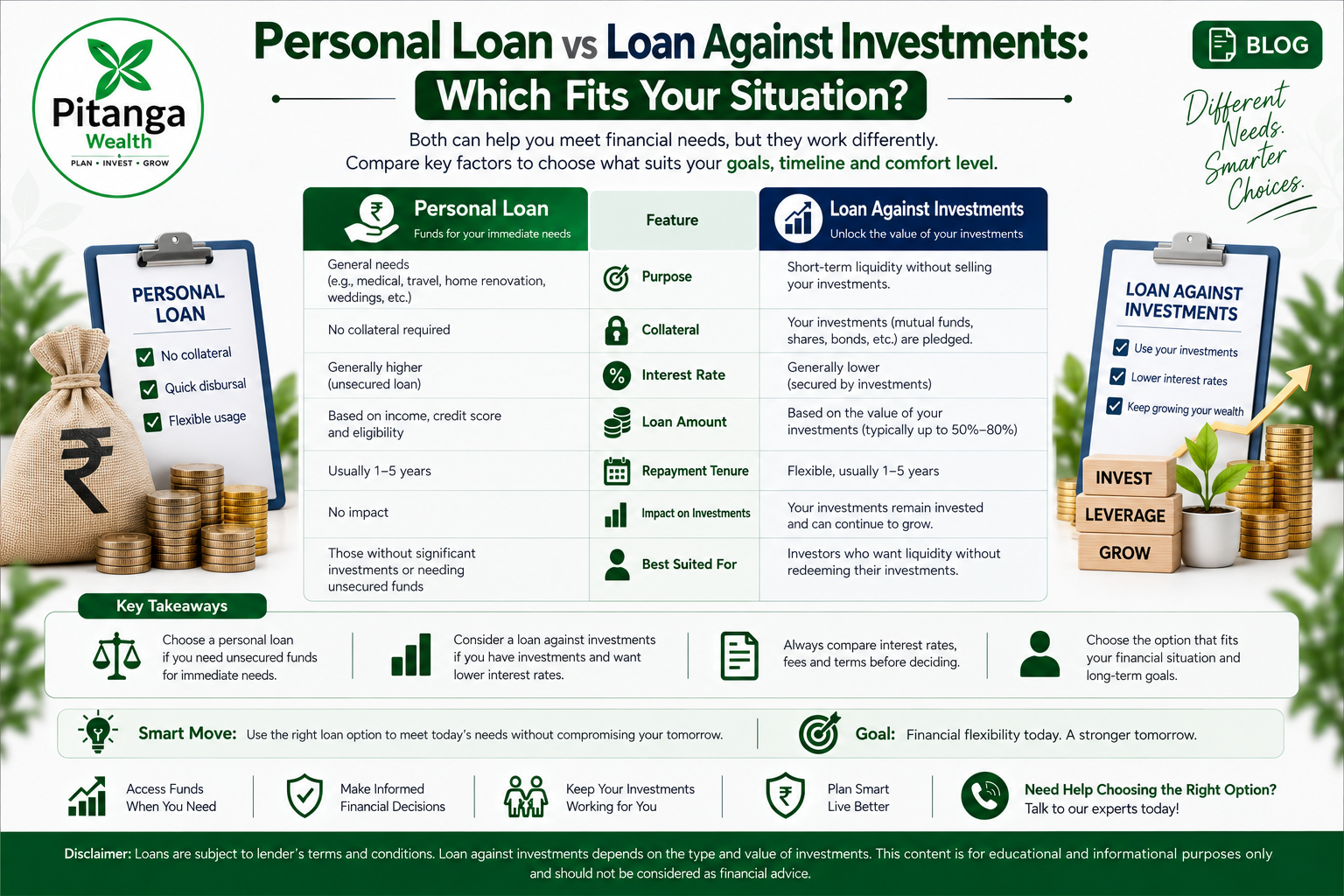
Personal loan vs loan against investments is a decision a lot of people face without fully weighing both sides, usually because one option (the personal loan) is more familiar and more aggressively marketed than the other. Here’s how the two actually compare, so the decision is made with full information rather than by default.

What Is a Personal Loan?
A personal loan is unsecured borrowing — the lender isn’t holding any of your assets as collateral. Approval is based primarily on your income, credit score, and repayment history, and the loan amount, tenure, and interest rate are determined accordingly.
What defines it:
- No collateral required. You don’t need to pledge anything you own, which is part of why it feels simpler.
- Approval is typically faster, especially with pre-approved offers or digital lending platforms, since there’s no asset valuation or lien-marking process involved.
- Interest rates are generally higher than secured borrowing, since the lender is taking on more risk by not holding collateral against the loan.
- Loan amount is tied to your income and credit profile, not to any asset value, so it’s capped differently than an investment-backed loan would be.
What Is a Loan Against Investments?
A loan against investments — commonly mutual funds, shares, bonds, or insurance policies — lets you borrow by pledging assets you already own as collateral, without selling them. The lender places a lien on the pledged investments, and you continue to hold ownership while the loan is active.
What defines it:
- Requires eligible collateral. You need investments the lender is willing to accept, and not every asset or scheme automatically qualifies.
- Interest rates are generally lower than unsecured personal loans, since the lender has collateral to fall back on if repayment doesn’t happen.
- Loan amount is tied to the value of your pledged investments, subject to a loan-to-value ratio that varies by asset type and lender.
- Carries a specific risk unsecured loans don’t: if the pledged investment’s value falls significantly (particularly relevant for market-linked assets), the lender may issue a margin call requiring additional collateral or partial repayment.
Personal Loan vs Loan Against Investments: The Core Difference
Laid out side by side, the structural trade-offs become much clearer:
| Personal Loan | Loan Against Investments | |
| Collateral required | None | Yes — eligible investments |
| Interest rate | Generally higher | Generally lower |
| Approval speed | Often faster, especially pre-approved offers | Depends on lien-marking process; can still be quick |
| Loan amount basis | Income and credit score | Value of pledged investments |
| Ongoing risk | None tied to market movement | Possible margin call if asset value falls |
| Impact on existing investments | None | Investments remain pledged and can’t be freely redeemed |

Why the Interest Rate Actually Differs
This comes down to risk from the lender’s perspective, not an arbitrary pricing decision. With a personal loan, if you’re unable to repay, the lender has no asset to recover value from beyond pursuing collection through other means — that risk gets priced into a higher interest rate. With a loan against investments, the lender holds a lien on an asset with real, trackable value, which reduces their risk and is typically reflected in a comparatively lower rate. Exact rates vary meaningfully by lender, loan amount, and current market conditions, so it’s not something with a fixed number worth quoting here — but the direction of the difference (secured typically cheaper than unsecured) holds fairly consistently.
The Real Trade-off: Simplicity vs Cost
This is really what personal loan vs loan against investments comes down to for most borrowers. A personal loan is simpler in the sense that there’s nothing to pledge, no lien to track, and no market-linked risk hanging over the loan itself. A loan against investments is typically cheaper and doesn’t force you to disturb assets you’d rather keep invested, but it introduces a dependency on your portfolio’s value that a personal loan simply doesn’t have.
Neither is a universally better choice — it depends on whether you have eligible investments to pledge in the first place, how you feel about the margin call risk, and how much the interest rate difference actually matters for your specific loan amount and tenure.
When a Personal Loan Might Make More Sense
- You don’t hold investments that qualify as eligible collateral, or the amount you’d need exceeds what you could reasonably borrow against them
- The loan amount is relatively small and short-term, where the interest cost difference may not be significant in absolute terms
- You’d rather avoid any risk tied to market movement affecting your loan, even if it means a higher rate
- You need funds urgently and a pre-approved personal loan offer is already available to you
When a Loan Against Investments Might Make More Sense
- You hold investments that qualify, and would rather borrow against them than redeem and disrupt a long-term investment plan
- The loan amount is large enough that the interest rate difference meaningfully affects total cost
- You’re comfortable monitoring the loan and responding to a margin call if your pledged asset’s value falls
- You want to preserve your investment’s tax treatment and compounding, which a redemption would interrupt
A Quick Note on Your Credit Score
Both loan types are generally reported to credit bureaus and affect your credit report, so the idea that a loan against investments “doesn’t count” the way a personal loan does isn’t accurate. Timely repayment on either helps your credit history; missed payments on either can hurt it. The presence of collateral affects the lender’s risk, not whether the loan shows up on your credit report.

Common Mistakes People Make With This Decision
Choosing a personal loan purely for convenience, without comparing the actual cost. Pre-approved offers feel easy to accept, but that convenience can come at a real, avoidable cost if a loan against investments was available and cheaper for the same amount.
Pledging investments meant for a critical long-term goal without weighing the margin call risk. Not every investment is equally suited to being pledged — funds earmarked for retirement or a child’s education carry a different risk conversation than more flexible investments.
Not actually comparing total cost, not just the headline rate. Processing fees, foreclosure charges, and how the loan is structured (term loan vs overdraft-style facility) all affect the real cost of borrowing, on both sides of this comparison.
There’s no universally right answer to personal loan vs loan against investments — it genuinely comes down to what you’re willing to pledge, and what the specific numbers look like for your situation.
Frequently Asked Questions
Is a loan against investments always cheaper than a personal loan? It’s generally lower in interest rate due to the collateral involved, but “always” isn’t accurate — it depends on the specific lender, loan amount, and prevailing rates on both products. It’s worth comparing actual offers rather than assuming the direction holds in every case.
Can I take a personal loan and a loan against investments at the same time? Yes, there’s no rule against holding both, though your overall eligibility and repayment capacity across all your loans will be considered by any new lender you approach.
What happens to my loan against investments if the market falls significantly? You may face a margin call, requiring you to either pledge additional collateral or repay part of the loan to restore the required ratio. If this isn’t addressed within the lender’s timeframe, they may redeem enough of your pledged units to cover the shortfall.
Does a personal loan process faster than a loan against investments? Often yes, particularly for pre-approved offers where no fresh underwriting is needed. A loan against investments involves a lien-marking step, though this has become considerably faster with digital processes at many lenders.
Which option is better for a short-term cash need? For smaller, short-term needs, the simplicity of a personal loan may outweigh the interest rate difference, especially if the amount and tenure mean the total cost gap is modest. For larger amounts or longer tenures, the rate difference tends to matter more.
Do I lose ownership of my investments if I pledge them for a loan? No — pledging places a lien restricting redemption, but you remain the legal owner throughout, and the investment continues to move with the market as it normally would.
If you’re weighing a personal loan against pledging your existing investments for funds, our team at Pitanga Wealth can help you think through which option actually costs less and fits your situation.
Mutual Fund investments are subject to market risks. Read all scheme-related documents carefully before investing. Loan terms, interest rates, and eligibility criteria vary by lender and are subject to change; this article is for educational purposes only and does not constitute financial or lending advice. Pitanga Wealth is an AMFI-Registered Mutual Fund Distributor (ARN-134606).
Written by the Pitanga Wealth team.
📲 Borrowing decisions like this one are exactly what we break down on Instagram — follow @pitangawealth for more real-money comparisons like this, explained simply.
This article is for educational and informational purposes only. It is not investment, tax, legal or insurance advice. Consider your circumstances and relevant documents before making a financial decision.